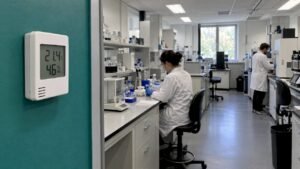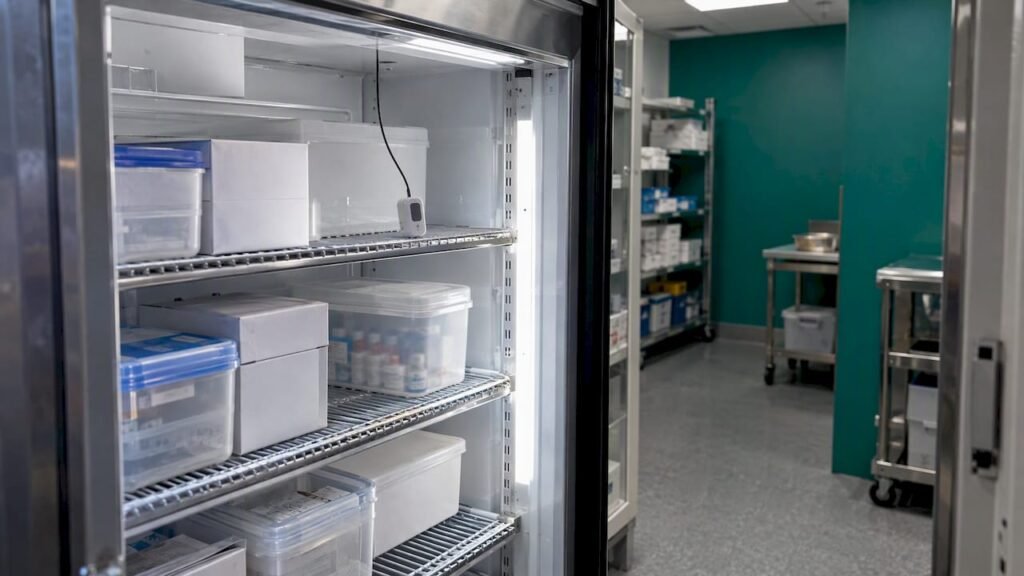
Healthcare temperature monitoring is the continuous measurement, alarming and recording of temperature in the places where medications, vaccines, samples and supplies are stored, so that you can show an auditor, at any time, that every product stayed within its required range. This guide explains what to monitor, which ranges and rules apply, how to choose and validate a system, and which records you need to keep.
TL;DR
- Monitor continuously and keep a traceable record: vaccine guidance says temperatures must be monitored, recorded and reported across the whole supply chain.
- Place sensors where variability is greatest, map the space first, and calibrate sensors over their full operating range.
- Alarms need high and low set points, a local signal and automatic phone or SMS notice to named staff.
- Every excursion needs a documented response: who was told, what was done, and what happened to the product.
- Choose a system through a written user requirements specification, then confirm it with installation and operational qualification (IQ/OQ).
Table of Contents
- What temperature monitoring covers and the risks it prevents
- Where healthcare temperature monitoring is needed
- Common ranges and monitoring rules
- How to choose a temperature monitoring system
- Sensor placement, mapping and calibration
- Alarms, excursions and system failures
- Records that keep you audit-ready
- Perspective: why we favor a managed, proactive design
- How we can help
- FAQ
- Sources
What temperature monitoring covers and the risks it prevents
In a regulated setting, monitoring is more than a thermometer on a door. It is a system of sensors, alarms, escalation rules and records. The World Health Organization states that the temperatures to which vaccines are exposed must be monitored, recorded and reported from the manufacturer to the point of vaccination. The same logic applies to any product whose quality depends on temperature.
The risks are practical:
- Product loss. Proper storage and transport conditions preserve the safety, quality and efficacy of drugs, according to Health Canada. The same guidance notes that a brief excursion may be acceptable only when stability data and scientific justification show quality is unaffected. You need data to make that case.
- Unreliable history. The CDC says an accurate temperature history that reflects actual vaccine temperatures is critical for protecting vaccines. A log that nobody can trust protects nothing.
- Invalid results. In laboratories, out-of-range rooms and incubators can compromise analytical work, which is why environmental conditions are monitored and recorded.
- Audit findings. Gaps in records, unexplained data holes and unsigned reviews are among the first things an inspector looks for.
Where healthcare temperature monitoring is needed
The WHO technical supplement on fixed storage names hospital pharmacies, laboratories, blood and tissue banks and pharmaceutical warehouses as environments where time- and temperature-sensitive products, such as biologics and vaccines, are held. In practice, a hospital campus usually includes several of them at once:
- Pharmacy refrigerators, freezers and controlled room temperature areas
- Clinical medication fridges on nursing units
- Laboratory refrigerators, freezers, incubators and sample storage rooms
- Blood bank and tissue storage
- Central supply and warehouse space
Laboratory storage matters as much as pharmacy storage. The FDA Laboratory Manual, which applies to FDA Office of Regulatory Science (ORS) laboratories, says storage areas should properly protect samples, reagents, standards and reference materials, and that separate areas help prevent contamination or degradation.
If you manage a campus with very different spaces, our article on temperature monitoring across mixed-use hospital campuses covers how to organize them under one design.
Common ranges and monitoring rules
The correct range is always the one on the product label or in the manufacturer’s stability data. The figures below are reference points from official sources, not substitutes for your product documentation.
| Use case | Reference range or rule | Source |
|---|---|---|
| Refrigerator for patient samples | Typically 2 to 8°C (36 to 46°F) | CDC job aid |
| Sample-storage freezer | Often −25 to −15°C (−13 to 5°F) | CDC job aid |
| Sensor accuracy, fixed pharmaceutical storage | Electronic sensors accurate to ±0.5°C or better | WHO supplement |
| Default heat alarm, stationary refrigeration appliances | +8°C or above for 10 hours | WHO PQS specification |
| Default power alarm, stationary appliances | More than 24 hours without power | WHO PQS specification |
| FDA ORS laboratory rooms where temperature and humidity affect results | Monitor and record both | FDA Laboratory Manual |
The WHO alarm defaults come from cold-chain appliance specifications. Hospital pharmacies often set tighter delays because a refrigerator full of biologics has less tolerance than a vaccine appliance designed for long holdover. Set your own thresholds from product stability data and document the reasoning.
USDA FSIS-regulated meat and poultry establishments work under separate stabilization guidance; this is not a general healthcare temperature-monitoring rule. The USDA FSIS stabilization guideline recommends measuring product temperature during cooling in 15 to 30 minute increments while product is between 130°F and 80°F. It also says monitoring procedures must account for normal equipment variation, for example ±2°F, by adjusting critical limits.
For a closer look at the medication fridge itself, see safer temperature ranges for hospital medication fridges and the causes of medical fridge temperature swings.
How to choose a temperature monitoring system
Start with a written user requirements specification (URS), not a product demonstration. WHO guidance says systems should be selected to match the application: a small pharmaceutical store, a large warehouse and a multi-site network need different solutions. A URS makes that match explicit and gives your validation team something to test against.
A practical URS for a hospital or laboratory covers:
- Parameters. Temperature always; humidity, pressure and particulates where the space or process requires them.
- Locations and equipment. Every refrigerator, freezer, incubator, room and warehouse zone, with owners named.
- Accuracy and range. The sensor accuracy you require and the operating range over which it must be proven.
- Alarm behavior. Set points, delays, notification channels, escalation order and acknowledgment.
- Data integrity. Electronic records, audit trails, electronic signatures, user access control and backup. US facilities typically assess these against FDA’s electronic records rules (21 CFR Part 11) and ALCOA+ principles.
- Network resilience. What happens to data and alarms when a connection or power source fails.
- Support. Calibration, sensor replacement, validation documentation and response outside business hours.
The WHO supplement adds that monitoring systems should be linked to integrated alarm functions and tested during IQ/OQ. Our validation guide for IQ, OQ and PQ walks through that sequence, and the hospital buyer guide turns the URS into vendor questions. A vendor scorecard for hospital labs helps you compare offers on the same criteria.
Sensor placement, mapping and calibration
Place sensors where the risk is
The WHO supplement says sensors in fixed storage should sit where the greatest variability is expected and should be minimally affected by transient events such as door openings. A sensor next to the door will alarm on every delivery. A sensor in the most stable corner will miss the real problem.
Map before you decide
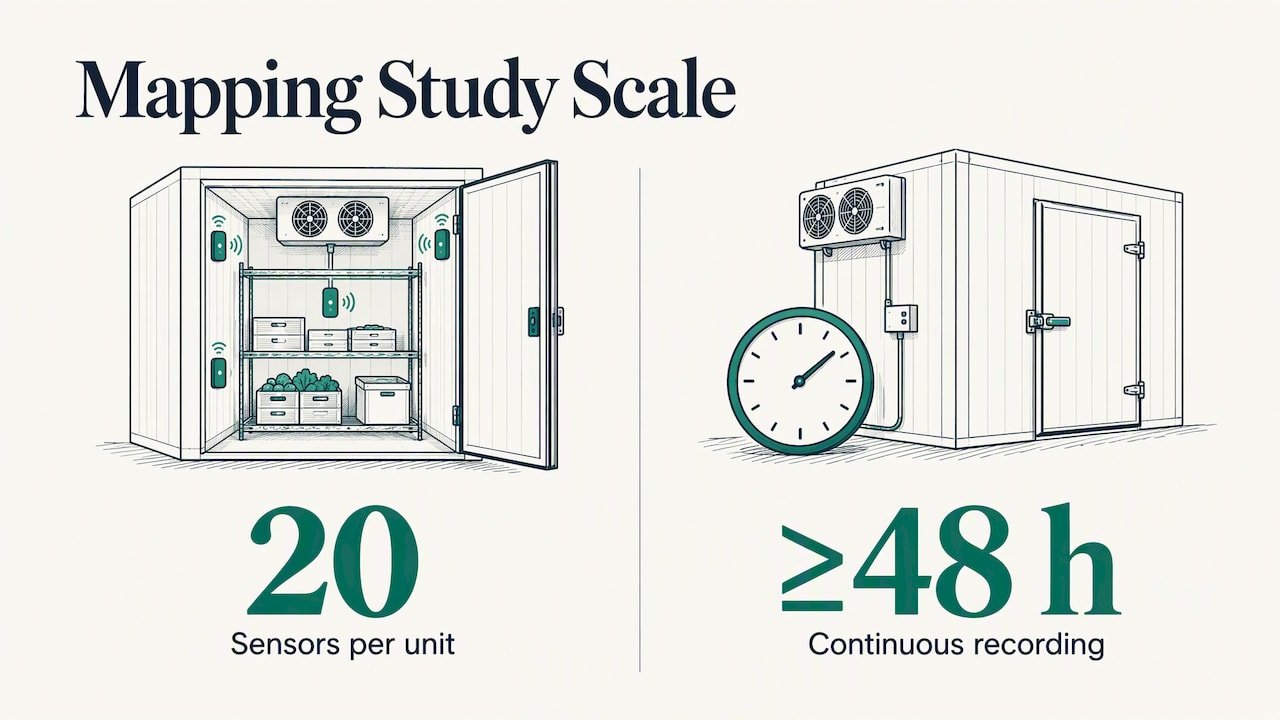
Temperature mapping finds the worst-case locations. Health Canada notes that mapping identifies where temperatures are most likely to deviate, so monitoring can be done at the most appropriate locations. For scale, WHO mapping guidance generally uses 20 sensors for a medium-sized cold-storage unit, recording continuously for at least 48 hours.
Validate under worst-case conditions too. The USDA FSIS guideline gives the example of testing fully loaded versus empty coolers, and the same thinking applies to a pharmacy walk-in at its busiest. Our guides on refrigerator mapping lapses, GMP cold room mapping and warehouse seasonal studies cover study design in detail.
Calibrate over the full range
WHO guidance on checking accuracy says temperature measurement and control devices must generally be calibrated periodically to prove accuracy across their full operating range. The UK NHS Specialist Pharmacy Service adds that sensors not routinely calibrated can drift, and recommends annual calibration to ±0.5°C by a UKAS-accredited service. It also describes three-point calibration for departments under an MHRA licence. Those are UK rules, so US facilities should look for equivalent traceability: calibration by an ISO/IEC 17025 accredited laboratory with certificates tied to each sensor.
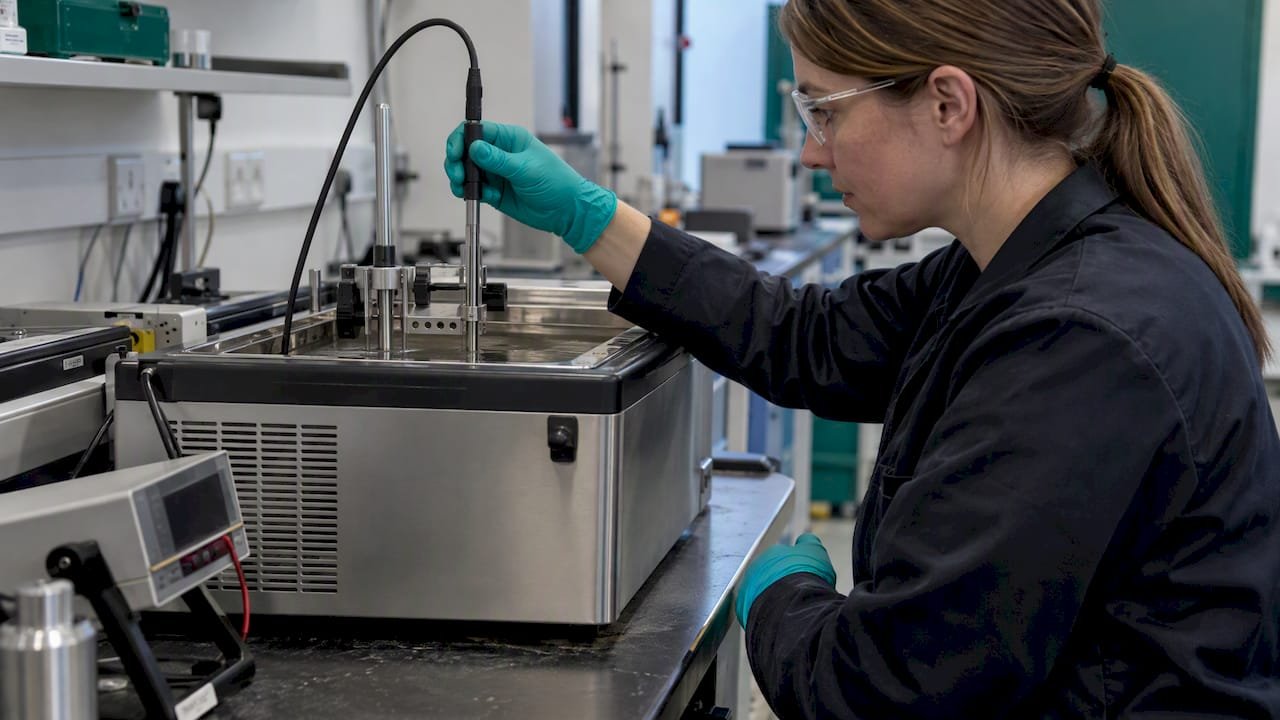
A calibration event should not create an unexplained gap in your data. Plan sensor swaps so that a replacement is already recording before the old sensor is removed. See how to validate temperature sensors in regulated labs and our data logger calibration service strategy.
Alarms, excursions and system failures
An alarm that reaches nobody is only a record of a failure. WHO guidance says alarm systems should have high and low set points, a visual alarm and preferably an audible one, and automatic telephone or SMS warnings to key personnel.
Define the response before the first alarm:
- Who is called, in what order, and what happens if the first person does not acknowledge.
- What staff do at the unit. Check the door, the power and the display; move product only under your written procedure.
- What happens to the product. Quarantine it until someone with authority has compared the recorded excursion with stability data.
- What gets written down. Time of alarm, acknowledgment, cause, corrective action and product disposition.
The CDC job aid gives the baseline for laboratory work: if a temperature is outside the recommended range, stop testing, contact the person supervising the work, and document corrective actions. For FDA ORS laboratories, the FDA Laboratory Manual similarly warns that calibrations or analytical work must not be performed when monitoring shows required environmental conditions are not met.
Failures of the monitoring system itself need the same discipline. The US EPA’s microbiology laboratory uses an electronic monitoring and alarm system for incubators, refrigerators, freezers and sample storage rooms, with procedures for non-conforming data and corrective action. Follow that model: write down what happens during an outage, how gaps are bridged and how they are explained afterward.
For templates, see our hospital temperature excursion response plan and the governance and escalation workflows for assigning roles.
Records that keep you audit-ready
The CDC job aid describes the minimum for manual logs: dated and initialed entries, documented corrective actions, and monthly logs reviewed and signed by the supervising person. Electronic systems should deliver the same discipline automatically, with user-attributed actions and a trail that cannot be silently edited.
Food establishments face explicit retention rules. USDA FSIS requires daily records of sanitation procedures and corrective actions, kept for at least six months and available to FSIS. Healthcare and pharmaceutical retention periods vary by regulator and record type, so confirm yours with your compliance officer.
A working audit file normally holds:
- The URS, validation protocols and IQ/OQ/PQ reports
- Mapping studies and the rationale for sensor locations
- Calibration certificates for every sensor
- Alarm set points and the reasons for them
- Excursion reports with product disposition
- Change control records and revalidation triggers, covered in our change control guide
The point of continuous monitoring beyond audits is that this file builds itself every day, so inspection week is not a scramble.
Perspective: why we favor a managed, proactive design
We see the same pattern in hospitals, laboratories and food operations: the sensors are rarely the problem. The gaps appear around them, in an unvalidated alarm path, a calibration that left a hole in the data, or a handoff nobody owned.
That is why our system is designed as a managed service rather than a box of loggers. We combine continuous parameter coverage, real-time alarms and traceable records with electronic signatures and ALCOA+ integrity, and we deliver installation, validation and ongoing support together. The aim is to find gaps before they become excursions.
Our position is simple: monitoring that is validated, supported and documented by one accountable team is easier to defend in an audit than monitoring assembled from parts. Facilities with several sites gain most, because every site then follows the same records and escalation logic.
the author
How we can help
Qualified Controls delivers regulated environmental monitoring for hospitals, pharmacies, laboratories, research institutions and food safety operations. Our sensors cover temperature, humidity, pressure and particulates, and our software provides real-time alarms, electronic audit trails and documentation designed for audit readiness. Hardware options are on our technology page.
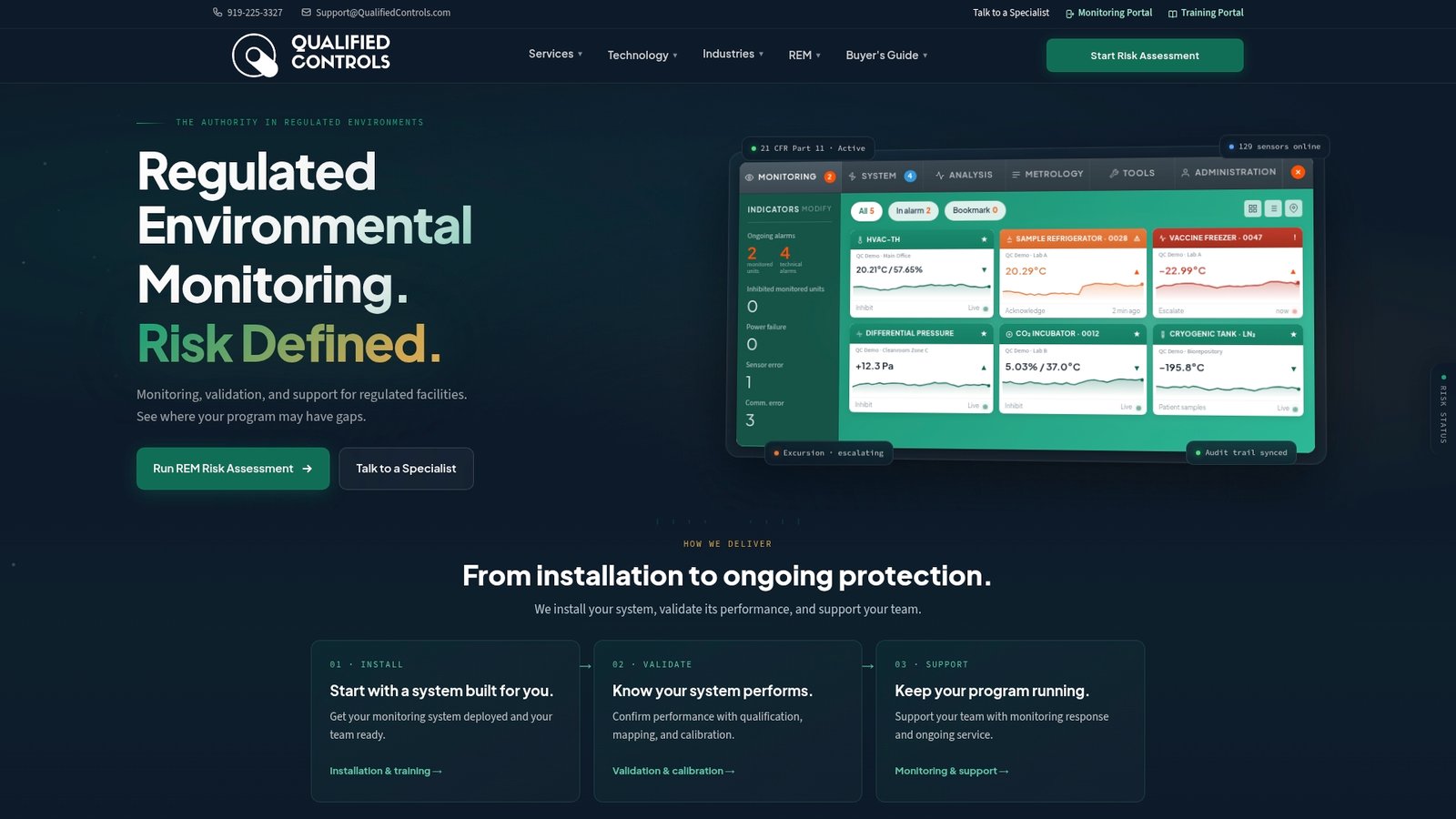
Services include installation and deployment, mapping and qualification, IQ/OQ/PQ validation, ISO 17025 calibration, 24/7 monitoring response and audit support. Published platform subscription plans on our pricing page are Initial at $4,500 per year, Serenity at $12,500 per year and Advanced at $22,500 per year, with Enterprise available on request. These displayed annual prices are for the 250-sensor capacity plan with a 12-month commitment and annual billing; pricing varies by capacity and contract. Hardware, equipment services and calibration are separate unless included in the agreed scope. Services and 24/7 response depend on the selected service tier and scope. Support tiers are described on our support page, and you can reach us through our main site.
FAQ
What temperature should a hospital medication refrigerator be kept at?
Use the range on the product label. As a reference, the CDC job aid gives 2 to 8°C (36 to 46°F) as typical for refrigerators storing patient samples. Many facilities also set internal alert points inside that band so staff can act before a true excursion.
How often should temperature sensors be calibrated?
It depends on your regulator, your risk assessment and the manufacturer’s guidance. The UK NHS pharmacy service recommends annual calibration to ±0.5°C, and WHO says devices must be calibrated periodically across their full range. Document your interval and the reasoning behind it.
Is a manual temperature log enough?
Manual logs can satisfy some requirements if they are dated, initialed, reviewed and signed, as the CDC job aid describes. They only record the moments someone looks, though, so a continuous system with alarms covers nights, weekends and short excursions that a manual check would miss. See our guide to automating hospital pharmacy temperature checks.
What should we do when a refrigerator goes out of range?
Follow your written procedure: notify the responsible person, stop any dependent work, secure the product and document the cause, the corrective action and the product decision. Any decision to use or discard product should rest on stability data, as Health Canada’s guidance explains.
Which standards apply to a hospital pharmacy?
The frameworks vary with the product and the facility, and commonly include FDA requirements, CDC vaccine storage guidance, accreditation standards and ISO/IEC 17025 for calibration. Confirm the current requirements with your compliance officer, and see our article on improving pharmacy compliance with monitoring systems.
Sources
- WHO: How to monitor temperatures in the vaccine supply chain
- Health Canada: Guidelines for temperature control of drug products
- CDC: Vaccine Storage and Handling Toolkit
- WHO: Temperature and humidity monitoring systems for fixed storage areas
- WHO: Temperature and humidity monitoring systems, technical supplement (CDN copy)
- CDC: Temperature Log Instructions Job Aid
- WHO PQS E006 specification, 2023
- FDA Laboratory Manual
- USDA FSIS: Stabilization Guideline for Meat and Poultry Products
- WHO: How to temperature map cold chain equipment and storage
- WHO: Checking the accuracy of temperature control and monitoring devices
- NHS Specialist Pharmacy Service: Using temperature sensors in medicines storage areas
- US EPA: Monitoring environmental parameters of incubators
- USDA FSIS: Sanitation SOPs