Compliance BeginsBefore The First Reading.
A monitoring system is only defensible if its sensors are calibrated to a known standard, mapped to the spaces they protect, and validated through a documented protocol. We handle all three — so the data your auditor reviews is verifiable from the first decimal place.
Every reading verifiable to the national standard.
Calibration is what turns a sensor reading into evidence. Calibrations are performed onsite and through ISO 17025 accredited labs against NIST-traceable references — issued with serialized certificates, multi-point coverage, and explicit deltas at every check.
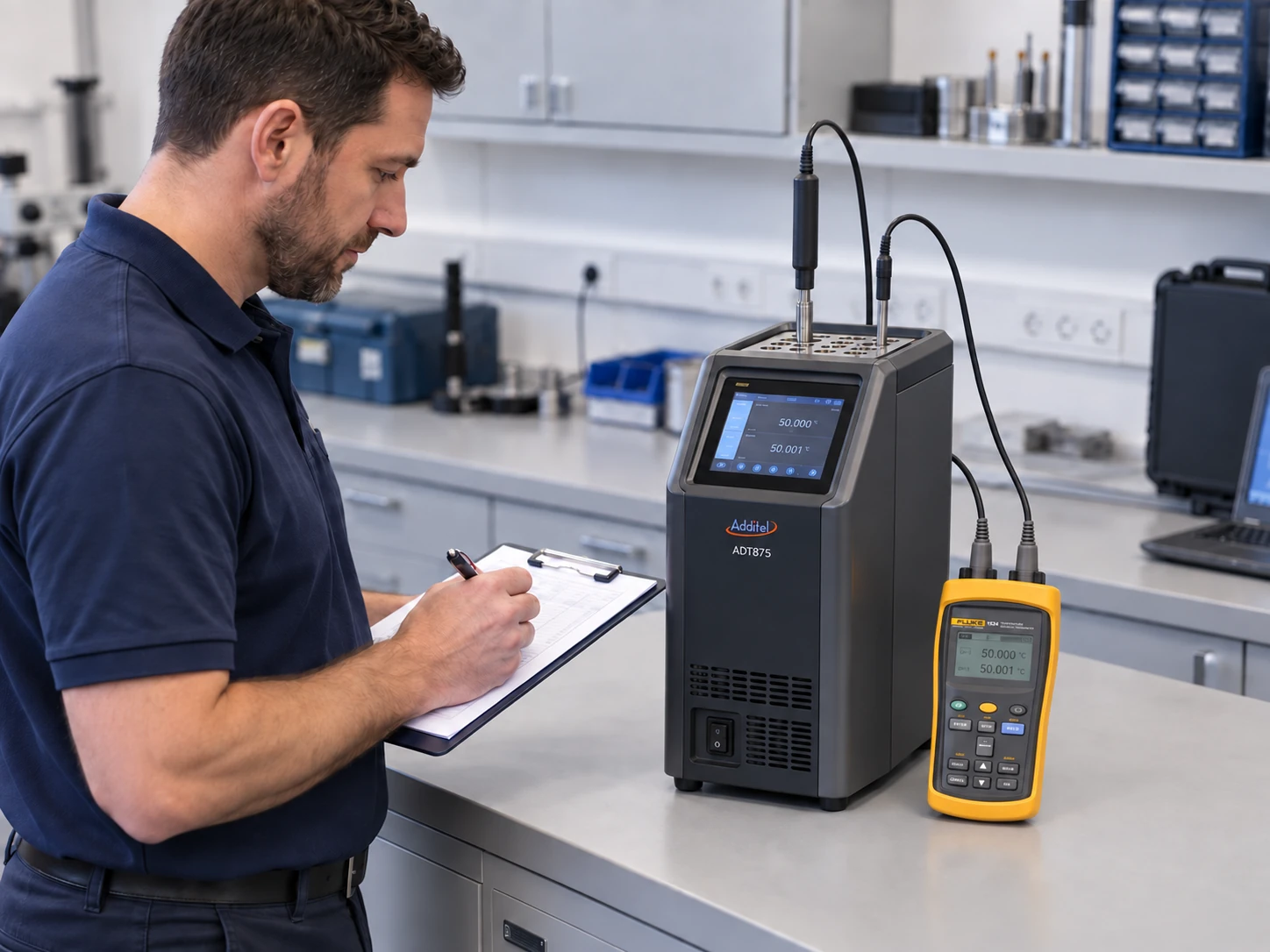
Calibration performed at your facility against portable NIST-traceable references. No sensor removal, no monitoring gap.
Multi-point calibration through ISO 17025 accredited labs — environmental chambers, dual-redundant references, and full documentation.
NIST-traceable certificates
Every sensor calibration ships with a serialized certificate that traces back to a National Institute of Standards reference. Tolerance, points tested, deltas, and accreditation are all explicit on a single page.
ISO 17025 accredited methods
Calibration procedures, reference standards, and uncertainty budgets are governed by ISO 17025 accreditation. The methods aren't just defensible — they're externally audited on the cycle the standard demands.
Multi-point coverage
Calibrations span the full operating range — typically 4-point for temperature, with deltas recorded at each point. The curve is explicit and the tolerance is visible everywhere on it.
On the schedule your protocol demands
Quarterly, semi-annual, or annual cycles. We track your calibration intervals against your validation protocol so nothing drifts out of period — and we surface the schedule inside MySirius alongside the live readings.
Need calibration with zero monitoring downtime?
Hot-Swap Sensor Service ships pre-calibrated, identical sensors so your team performs a five-minute swap. The original returns for recalibration — monitoring never goes dark.
Schedule
We align cycles to your validation protocol and audit calendar — no surprise expirations.
Calibrate
Multi-point calibration onsite or through ISO 17025 accredited labs against NIST-traceable references.
Document
Certificate issued with deltas, tolerance, uncertainty, and full chain-of-custody — attached to the asset record.
Track
Calibration status surfaces in MySirius alongside the live reading; the next-due date drives the next cycle.
Need calibration? Schedule yours today.
We'll align the calibration to your procedures and confirm a date — onsite or in lab.
See where the air actually
stratifies, drifts, and recovers.
A monitoring sensor protects only the volume it can actually represent. Mapping studies expose the thermal, humidity, and pressure behavior of the real space — so sensor placement is driven by physics, not floor plans.
Distributed sensor study
A grid of calibrated thermal mappers placed at representative volumes — corners, returns, supply diffusers, product faces. Coverage is determined by the chamber's geometry and operating envelope, not a fixed checklist.
Loaded, unloaded, & recovery profiles
The space is mapped in each operational state — at rest, under load, and during recovery from door-open or power-cycle events. The chamber's worst-case behavior gets named, not estimated.
Hot & cold spot identification
Heat-mapped output identifies the locations of greatest gradient — the points that need permanent monitoring sensors and the volumes where storage should be excluded.
Qualification report & placement plan
Output is a signed mapping & qualification report — heat maps, recovery curves, statistical summaries, and a sensor-placement plan you can hand to your validation team and your auditor.
Scope
Walk-through of the chamber, warehouse, or transit envelope; placement strategy is drafted from geometry and operating profile.
Deploy
Calibrated mappers are positioned across the volume — ceilings, returns, product faces, transit dunnage. Logging begins.
Analyze
Loaded, unloaded, and recovery profiles are extracted. Hot and cold spots are statistically isolated.
Qualify
Signed report with heat maps, recovery curves, and a permanent-sensor placement plan ready for protocol approval.
Mapping refresh included as your facility evolves
Layout change, HVAC retrofit, new product line — under MaaS, re-qualification of the affected spaces is included on the same monthly subscription as hardware, software, and audit support.
One protocol. Three phases. Defensible end-to-end.
IQ confirms the system was installed as specified. OQ confirms it operates as specified. PQ confirms it performs in the real environment, under real load. Our validation team authors and executes the protocol — leaving you with a complete, audit-ready binder before the system goes live.
Installation Qualification
Confirms the MySirius environment is reachable and the network is configured to specification before any operational testing begins.
- MySirius Accessibility VerificationClient domain reachable from a workstation web browser.
- Network port verificationTCP 13252 (HTTP) or 8443 (HTTPS) open for LoRa gateways.
- Training prerequisites confirmedPersonnel training records on file before execution.
- Signed IQ reportDiscrepancies logged on QF08 and closed before OQ begins.
Operational Qualification
Exercises the system's regulated functions — access controls, recovery, alerts, and audit trail — against documented acceptance criteria.
- 21 CFR Part 11 & User Access ControlsAccounts, password policy, session limits, electronic signatures.
- Recovery from Service InterruptionPower loss, network failure, cellular failover, PDF / CSV reporting.
- Alert FunctionEmail, SMS, voice-call notifications and acknowledgement reasons.
- Audit Trail FunctionConnection, configuration, and data-change events captured.
Performance Qualification
Confirms the deployed system performs against the URS and is ready for client release into GxP production.
- Retrieval VerificationRecorded data retrievable and reportable from the live system.
- Client ReadinessSOPs, training records, and user roles in place for go-live.
- Validation Summary ReportURS / Traceability Matrix closed; discrepancies resolved.
- Signed PQ releasePost-execution approval by System Owner & Quality Assurance.
Single binder, three phases — authored, executed, and signed
The frameworks the protocol speaks to.
Run a Validation Readiness Check
Tell us where you are in the lifecycle — new system, mid-deployment, post-change. We'll return a phase-by-phase readiness map with gaps called out before you commit to a protocol.
One monthly fee.
Every part of your monitoring compliance.
Hardware, software, calibration, mapping refresh, validation upkeep, 24/7 monitoring response, and audit support — bundled into a single subscription so your facility focuses on its product, not on assembling a compliance stack.
Hardware
LoRa, Nano, Nano Link, and Digital sensor families plus gateways — provisioned and maintained.
Always-latest sensorsMySirius Software
Real-time logging, alarm management, ALCOA+ records, and on-demand audit-ready reporting.
21 CFR Part 11Calibration
Hot-swap cycles included. NIST-traceable, ISO 17025 accredited recalibration on the schedule you need.
NIST & ISO 1702524/7 Monitoring Response
Continuous alert triage and technical support — the operations team is on duty around the clock.
< 1 min first-touchAudit Support
Audit-ready record packs, narrative review before each inspection, and on-site liaison for high-stakes reviews.
FDA · USDA · GxPLifetime Warranty & Upgrades
System-wide lifetime warranty plus rolling sensor upgrades. Hardware advances ship to your sites — you never run aging fleet.
Always-latest hardwareMonitoring-as-a-Service
- Sensor hardware & gateway lifecycle
- MySirius platform license
- Hot-swap calibration cycles
- Mapping & qualification refresh
- 24/7 monitoring response
- Audit-pack assembly & on-site support
- Validation upkeep as your facility evolves
- Lifetime system warranty & upgrades
Run the ROI Calculator
Compare per-service costs against an MaaS subscription for your facility size, sensor count, validation frequency, and audit cadence. Receive a side-by-side projection in minutes.