HACCP has seven principles: conduct a hazard analysis, determine the critical control points (CCPs), establish critical limits, establish monitoring procedures, establish corrective actions, establish verification procedures, and establish record-keeping and documentation. The FDA’s HACCP guidelines list them in exactly this order, and each one builds on the one before it. This guide explains what each principle requires, how the principles work together, and what your records should show when a limit is exceeded.
TL;DR
- HACCP is built on seven principles, applied in sequence: hazard analysis, CCPs, critical limits, monitoring, corrective actions, verification, and documentation.
- A CCP is a step where control is essential to prevent or eliminate a food safety hazard, or reduce it to an acceptable level. Each CCP needs measurable critical limits.
- Monitoring tells you whether a limit is being met, and corrective actions, defined in advance, tell your team what to do when it is not.
- Prerequisite programs such as good manufacturing practices, calibration and training are the foundation under the plan.
- Temperature is the parameter most often held at a CCP, so continuous, traceable temperature records carry much of the evidence an auditor will ask for.
Table of Contents
- The seven principles at a glance
- The seven principles in detail
- How the principles work together
- Prerequisite programs: the foundation under the plan
- Temperature monitoring and HACCP records
- Our perspective
- Supporting your HACCP plan with continuous monitoring
- How HACCP rules differ by jurisdiction
- FAQ
- Sources
The seven principles at a glance
The table below summarizes the sequence. The wording follows the FDA guidelines, and the Codex version published by the FAO uses the same structure, with Principle 3 stressing validated limits and Principle 6 adding validation of the plan itself.
| # | Principle | The question it answers | Typical output |
|---|---|---|---|
| 1 | Conduct a hazard analysis | What could make this food unsafe? | Hazard list with control measures |
| 2 | Determine the CCPs | Where must we control it? | CCPs marked on the process flow |
| 3 | Establish critical limits | What value separates safe from unsafe? | Minimum and maximum values per CCP |
| 4 | Establish monitoring procedures | How and how often do we check? | Monitoring schedule and method |
| 5 | Establish corrective actions | What do we do when a limit is missed? | Written response and product disposition |
| 6 | Establish verification procedures | Is the plan working as designed? | Calibration, record review, audits |
| 7 | Establish record-keeping and documentation | Can we prove it? | Plan, logs, deviation and verification records |
The seven principles in detail
Principle 1: Conduct a hazard analysis
The FDA guidelines describe the hazard analysis in two stages. The first is hazard identification, a brainstorming session by the HACCP team that reviews ingredients, process steps, equipment, storage, distribution and intended use. The second is hazard evaluation, where the team decides which hazards must be addressed in the plan, based on their severity and likely occurrence.
Practical points for this stage:
- Build a complete process flow diagram first, from receiving through storage, preparation, cooking, cooling, holding and service or shipping.
- Consider biological, chemical and physical hazards at each step.
- Record the reasoning for hazards you decide not to control through the plan, since an auditor will ask.
- Note the control measure that addresses each significant hazard, such as cooking to a set temperature or holding product cold.
Principle 2: Determine the critical control points
The FAO defines a CCP as a step at which control can be applied and is essential to prevent or eliminate a food safety hazard, or reduce it to an acceptable level. The FDA guidelines say CCPs are identified using a decision tree or expert knowledge.
Two cautions help here. A step that merely matters for quality is not automatically a CCP. And a hazard controlled by a prerequisite program, such as routine handwashing, usually does not need its own CCP. Typical CCPs in food operations include cooking, cooling, cold storage, hot holding and receiving of temperature-sensitive product.
Principle 3: Establish critical limits
Each CCP has one or more critical limits: maximum or minimum values for a biological, chemical or physical parameter that separate safe from unsafe operating conditions. According to the FDA guidelines, limits may be based on temperature, time, physical dimensions, humidity, moisture level, water activity, pH, titratable acidity, salt concentration, available chlorine, viscosity, preservatives, or sensory information such as aroma and visual appearance, and they must be scientifically based.
The FAO’s guidance on developing a plan adds that limits must be validated and that the limits and permissible tolerances belong in the HACCP plan worksheet. A usable critical limit is specific: “cooler at or below 40°F” is a limit, while “keep product cold” is not.
Principle 4: Establish monitoring procedures
Monitoring is a planned sequence of observations or measurements that assesses whether a CCP is under control within its critical limits. A written monitoring procedure names:
- what is measured, and with which device;
- how often, or whether continuously;
- who is responsible for checking and signing;
- where the result is recorded.
A National Seafood HACCP Alliance example for hot smoked salmon sets the cooler critical limit at 40°F (4.4°C) or below, monitored by a continuous recording thermometer, with a visual check once a day by the cooler manager or a designee. This pairing of continuous measurement with a daily human review is a common design.
Principle 5: Establish corrective actions
Corrective actions are written in advance for each CCP. Per the FDA guidelines, they must determine and correct the cause of non-compliance, determine what happens to the affected product, and record what was done. The cooking example is simple: if the required internal temperature has not been reached, cooking continues until it is.
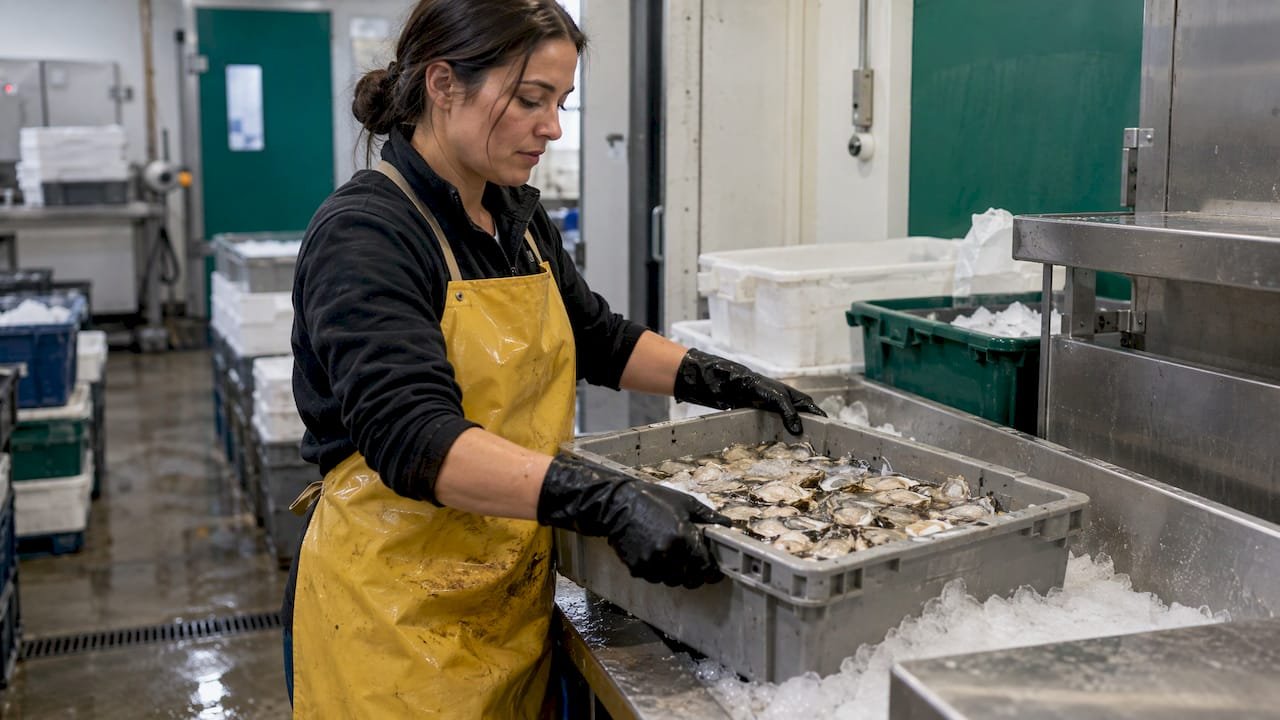
The National Seafood HACCP Alliance example for shucked oysters shows how graded a response can be. If the cooler exceeds 45°F (7.2°C), product is moved to another cooler or onto ice. If the internal temperature of the shellstock meats is above 50°F (10°C), the product must be destroyed.
Principle 6: Establish verification procedures
Verification confirms that the plan is operating effectively. Typical activities are reviewing monitoring and corrective action records, confirming that CCPs are being monitored as written, and checking instruments. The AFDO HACCP guide notes that procedures for calibration of instruments must be part of the plan under Principle 6. The Codex text also ties temperature control to this principle: it states that temperature monitoring and recording devices should be checked for accuracy and calibrated at regular intervals.
In practice, a verification program covers:
- Calibration of thermometers and data loggers against traceable references.
- Scheduled review of CCP records by someone other than the person who recorded them.
- Periodic reassessment of the plan when a product, process or piece of equipment changes.
- Internal or third-party audits.
For a deeper look at proving that a sensor reading can be trusted, see our article on calibration traceability.
Principle 7: Establish record-keeping and documentation
The FDA guidelines call for a summary of the hazard analysis, the HACCP plan summary table, supporting documentation and operational records. The FAO notes that records demonstrate that correct procedures were followed, offer product traceability, and provide a record of compliance with critical limits. In the UK, the same page points out, they can serve as evidence of the due diligence defense under the Food Safety Act 1990.
Good records are contemporaneous, attributable, legible and unaltered. For electronic systems that means time-stamped entries, user identification and an audit trail of any change.
How the principles work together
The principles form a loop rather than a checklist. The hazard analysis identifies what to control. CCPs and critical limits turn that into measurable targets. Monitoring watches the targets, corrective actions respond when they slip, and verification and documentation prove the whole system works and give you the evidence to improve it.
Here is a worked example for a walk-in cooler holding ready-to-eat product:
- Hazard: growth of pathogens if product warms.
- CCP: refrigerated storage.
- Critical limit: cooler at or below 41°F (5°C), or whatever limit your plan validates for that product.
- Monitoring: continuous temperature recording, with a documented daily review.
- Corrective action: move product, evaluate time out of range, and decide to release, hold or discard.
- Verification: calibrate the sensor on a schedule, and review weekly trend records.
- Records: the log, the deviation report, the calibration certificate and the review signature.
Prerequisite programs: the foundation under the plan
HACCP does not work alone. The HACCP Alliance document describes prerequisite programs such as current good manufacturing practices as an essential foundation. Common examples include sanitary facility design, supplier control, written ingredient specifications, equipment maintenance and calibration, cleaning and sanitation, personal hygiene, training, chemical control, proper storage conditions, traceability and recall, and pest control.
The EU’s Better Training for Safer Food booklet makes the same point: prerequisite hygiene requirements should be in place before a HACCP-based procedure is established. The UN/FAO introduction to HACCP adds that management commitment and training are essential, and that adopting HACCP only to satisfy a regulation can lead to failure. Treat the plan as an operating discipline, not a binder.
You may also hear of the “4 C’s” of food safety: cleaning, cooking, cross-contamination and chilling, sometimes extended to a fifth. They are a handy training shorthand for everyday practice. They are not a substitute for the seven principles, but they map neatly onto them: cooking and chilling are the points where CCPs and critical limits most often sit.
Temperature monitoring and HACCP records
The Codex text states that inadequate time and temperature control during cooking, cooling, processing and storage are among the most common failures of operational control. It also says temperature control systems that affect safety should be validated, monitored and recorded. That is why temperature so often becomes the critical limit, and why the quality of your temperature records matters.
When a limit is exceeded, a complete record shows:
- date and time of the excursion, and when it ended;
- location or measurement point;
- the measured value against the critical limit;
- the cause, where known;
- the corrective action taken;
- the responsible person;
- the product decision: release, hold, move or reject.
The FDA guidelines give the canned-food case: temperature and time for thermal processing are recorded continuously on charts, and if the temperature falls below the scheduled value or the time is insufficient, the product is retained and its disposition determined.
Manual spot checks leave gaps between readings, which is why many teams move to continuous capture. Our guides on HACCP temperature monitoring with continuous CCP records and time and temperature control for TCS foods walk through how this looks day to day, and our overview of automated monitoring versus manual checks covers the trade-offs.
Our perspective
We see the same pattern across regulated environments: the principles are rarely the problem. Teams usually understand hazard analysis and critical limits. The weak point is evidence. A limit that is checked twice a day leaves hours nobody can account for, and a calibration event that creates an unexplained gap in the record invites questions at audit.
Our approach to monitoring is built around that gap. We design continuous parameter coverage, real-time alarms and traceable records with electronic signatures and ALCOA+ data integrity, so the monitoring, corrective action and documentation principles are supported by one connected record rather than several disconnected ones.
We also deliver it as a managed service, with installation, validation, ISO 17025 calibration and ongoing support, because a system is only as defensible as the people and procedures around it. Our aim is to close compliance gaps before they become findings.
Brad Johnson
Supporting your HACCP plan with continuous monitoring
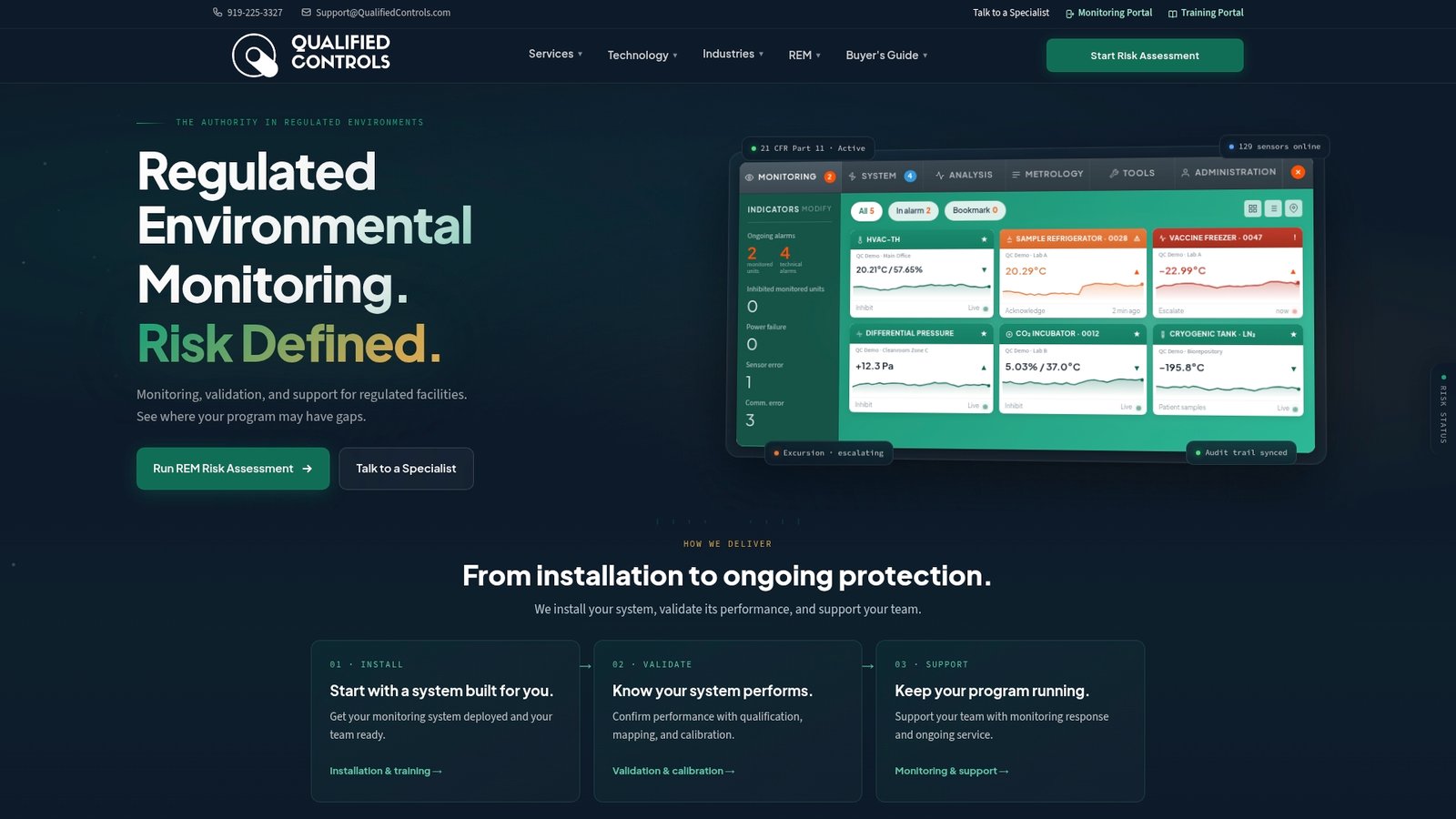
If your CCPs depend on temperature, we can help you turn Principles 4, 6 and 7 into a system that runs continuously. Our MySirius monitoring platform provides sensor coverage, real-time alarms and electronic audit trails, backed by installation, IQ/OQ/PQ validation, ISO 17025 calibration, audit support and 24/7 monitoring response.
Published annual plans start with Initial at $4,500 per year, Serenity at $12,500 per year and Advanced at $22,500 per year, with Enterprise available on request. See the details on our pricing page, or read how we support FSMA and HACCP temperature monitoring for food and beverage operations. Healthcare kitchens can start with our guide to food safety in hospital cafeterias.
How HACCP rules differ by jurisdiction
The seven principles are international, but their legal weight differs. In the United States, the USDA FSIS explains that the NACMCF working group published the principles and application guideline in August 1997, that the HACCP regulation sits in Title 9 of the Code of Federal Regulations, Part 417, and that the guideline itself is not enforceable. Under EU legislation, the Better Training for Safer Food booklet states, there is no legal requirement for HACCP certification, although customers may demand it for commercial reasons.
If you operate in more than one market, attribute each requirement to its own law and confirm the current text with the regulator that oversees your product category.
FAQ
How many basic principles does HACCP have?
HACCP has seven principles. The FDA lists them as hazard analysis, CCPs, critical limits, monitoring, corrective actions, verification, and record-keeping. The Codex version phrases some of them slightly differently, for example by adding validation of the plan to Principle 6, but the structure is the same.
What is a prerequisite program in HACCP?
It is a basic hygiene or operating control that must be in place before the HACCP plan can work. Examples include sanitation, supplier control, training, pest control, equipment calibration and proper storage conditions. HACCP is built on top of these programs and does not replace them.
What are the 5 C’s of food safety?
The commonly taught list is cleaning, cooking, cross-contamination and chilling, with a fifth item added in some training materials. It is a practical reminder for staff. Your HACCP plan is what documents the specific limits, monitoring and records behind those habits.
How would you explain HACCP in an interview?
Say that HACCP is a preventive system that identifies hazards, controls them at critical points with measurable limits, monitors those limits, defines corrective actions in advance, verifies the system, and keeps records. Then give one concrete example, such as a cooler with a 41°F limit, continuous monitoring and a documented response to excursions.
Sources
- HACCP Principles & Application Guidelines, FDA
- General principles of food hygiene, FAO
- Basic principles of HACCP, FAO
- Developing a HACCP plan, FAO
- Commercial Processing Example: Hot Smoked Salmon Fillets, National Seafood HACCP Alliance
- Commercial Processing Example: Shucked Oysters, National Seafood HACCP Alliance
- Hazard Analysis and Critical Control Point Principles and Application Guidelines, HACCP Alliance
- Better Training for Safer Food: HACCP systems booklet, European Commission
- An Introduction to HACCP, UN/FAO
- HACCP Seven Principles, USDA FSIS