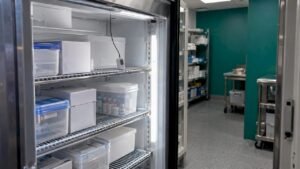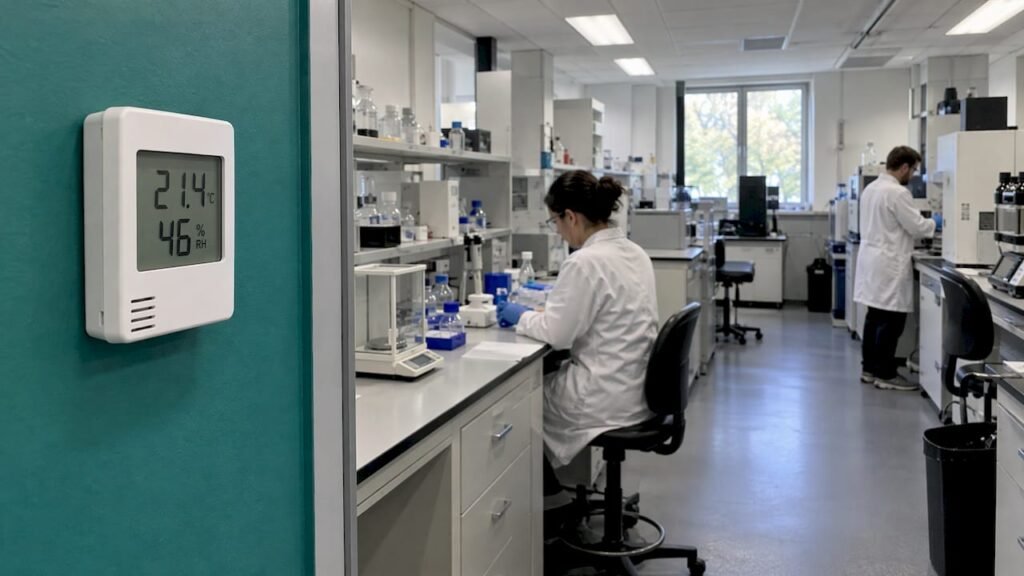
Laboratory environmental monitoring is the continuous measurement, recording and review of the conditions that affect your tests, samples and equipment, mainly temperature, humidity, pressure and particles. A sound program defines which parameters matter, sets limits for each, uses calibrated sensors, raises alarms in real time and keeps a traceable record you can show an auditor. This guide walks through each of those steps for healthcare, pharmaceutical, research and food-safety laboratories.
TL;DR
- Monitor every parameter that can influence a result, reagent, sample or instrument, and define a critical interval and a check frequency for each.
- Place sensors where variability is greatest, calibrate them against traceable references, and verify them between calibrations.
- Treat alarms, excursions and corrective actions as records: they must be timestamped, reviewed for trends and kept in a validated system.
- Requirements differ by sector and country, so map your obligations (ISO/IEC 17025, GMP, 21 CFR, GSP) before choosing a system.
- A managed service covering installation, validation, calibration and response can reduce the compliance workload on your team.
Table of Contents
- What laboratory environmental monitoring measures
- How to set limits for each parameter
- Laboratory temperature monitoring and control
- Building an environmental monitoring program step by step
- Regulations and standards that shape laboratory compliance
- Alarms, excursions and data integrity
- When your samples travel: cold chain considerations
- Our perspective: monitoring should find gaps before auditors do
- Choosing a monitoring system for your laboratory
- How Qualified Controls can support your lab
- FAQ
- Sources
What laboratory environmental monitoring measures
The EDQM divides laboratory environmental conditions into physical conditions, such as temperature, humidity and particle count, and microbiological conditions. It also states that monitoring, controlling and managing the testing environment is how a laboratory secures the overall quality of its functions.
In practice, most laboratories track some combination of the following:
- Temperature in rooms, refrigerators, freezers, incubators and stability chambers.
- Relative humidity in rooms and storage areas where moisture affects reagents, balances or samples.
- Differential pressure between clean and adjacent spaces, and air changes per hour.
- Particulates and gases such as CO2, oxygen or VOCs in cleanrooms, incubators and hazardous-materials areas.
- Door status, power and equipment faults that explain why a reading moved.
The reason this matters is simple. A reading outside its qualified range can invalidate a test, compromise a stored sample or put a product batch in question. Monitoring is how you find out before the consequences spread. For a deeper look at the parameters beyond temperature, see our guide to differential pressure, air changes, CO2/VOC, particles and leaks under GMP and GLP.
How to set limits for each parameter
Start with the work your laboratory actually does. The WHO Laboratory Quality Stepwise Implementation tool gives a clear sequence: list the parameters that could influence reagents, equipment or the examination, define the critical interval for each, define how often it is monitored (for example daily, weekly or monthly), and create a monitoring log for each parameter.
For general room conditions, the FDA ORA Laboratory Manual describes a comfortable working environment as 20 to 25 °C with relative humidity of 35 to 50%, depending on geographical area. It adds that temperature and humidity must be kept within the limits needed for the proper performance of each test. The same manual states that laboratories handling toxic materials are kept under negative pressure to adjoining areas with 8 to 12 air changes per hour, and that chemical hood face velocities must fall within 80 to 120 feet per minute.
Treat those numbers as reference points, not universal limits. Your final limits come from:
- The method, instrument or reagent manufacturer’s requirements.
- The qualified range established during mapping or qualification.
- The regulation or accreditation standard that governs your work.
- A risk assessment that decides where tighter alert limits belong inside the allowable range.
A useful habit is to set two tiers: an alert level that prompts a look before the condition becomes a deviation, and an action level that triggers the formal response. That structure is what lets a monitoring system identify a gap before it escalates.
Laboratory temperature monitoring and control
Temperature is the parameter most laboratories start with and the one auditors ask about first. Good practice has four parts: sensor selection, placement, calibration and verification.
Sensor accuracy and placement
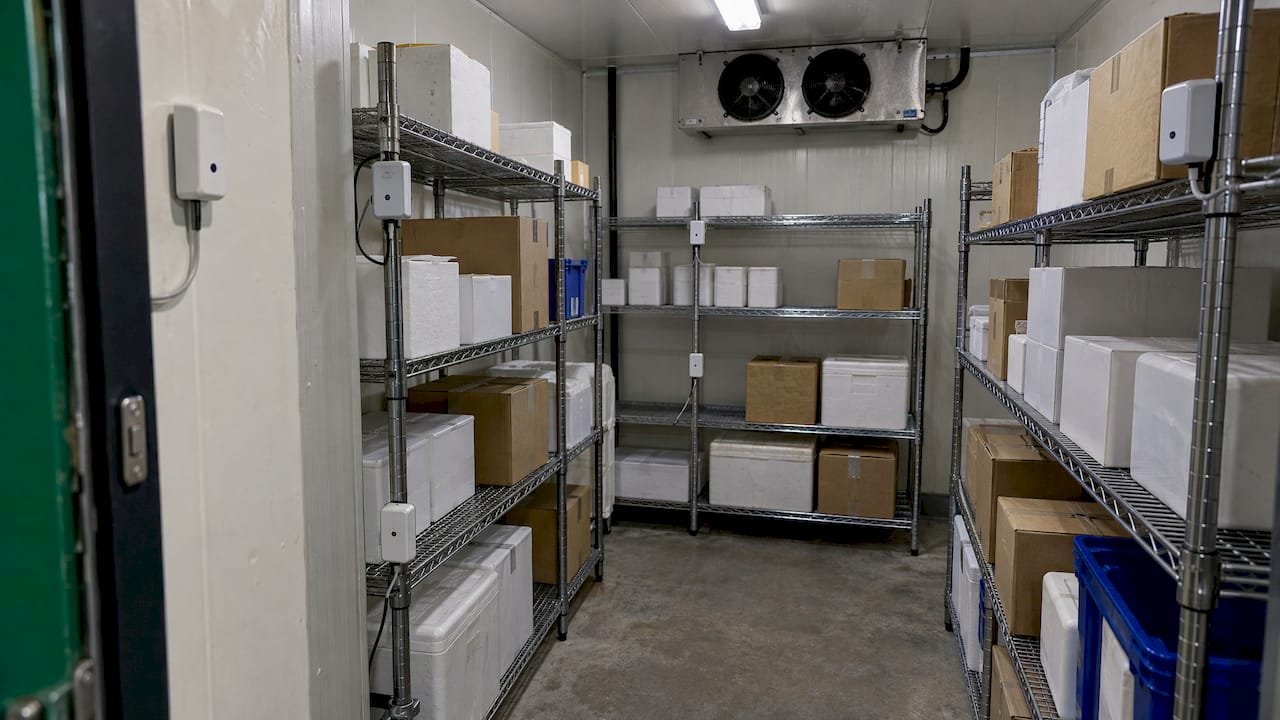
The WHO guidance on temperature and humidity monitoring systems states that electronic sensors for fixed storage areas holding time- and temperature-sensitive pharmaceutical products should be accurate to ±0.5 °C or better. It also says they should sit where the greatest temperature variability is expected within the qualified storage volume.
Finding that location is the purpose of a mapping study. WHO mapping guidance notes that about 20 sensors are generally used to map a medium-sized cold storage unit, plus one for ambient temperature, with continuous recording at regular intervals for at least 48 hours. Our GMP temperature mapping study design guide explains how to plan that work, and our article on empty versus loaded freezer mapping covers what validation teams often overlook.
Calibration and verification
Calibration and verification are different activities, and a lab needs both.
- Annual calibration. The New Zealand Blood Service Refrigeration Guidelines call for annual two-point calibration of the recorder and alarm system against a reference thermometer traceable to national standards, using points suited to the unit, for example 0 °C and 10 °C for blood fridges, and -80 °C and 0 °C for ultra-low freezers.
- Interim checks. The same guidelines require the accuracy of recorders to be checked every six months against a calibrated working or reference thermometer, to show the readout stays correct between annual probe calibrations.
- Defined tolerance for disagreement. The US EPA SOP EQ-02-10 requires annual point checks against a verification thermometer, and a difference greater than 1 °C triggers a consultation about replacement.
These are examples from specific organizations and countries. Your own schedule must follow your quality system and the standards that apply to you. What carries over everywhere is the principle that a calibration event should not create an unexplained gap in your data. That is why many teams use a hot-swap approach, replacing a sensor with a freshly calibrated one so monitoring continues. We compare the options in hot-swap versus on-site ISO 17025 calibration, and explain how to document the chain of reference in calibration traceability.
For selecting devices, see how to select sensors for audit-ready lab compliance.
Controlling the equipment itself
Monitoring tells you what happened; control keeps conditions in range. The ISPE Good Practice Guide on Controlled Temperature Chambers covers the lifecycle of chambers from design and qualification through maintenance and decommissioning, with a risk-based approach to GxP compliance. If your lab depends on incubators, stability chambers or walk-in rooms, that lifecycle view helps you decide what to qualify and how often to revisit it.
Building an environmental monitoring program step by step
A program that works at audit time is built in a deliberate order.
- Inventory your spaces and equipment. List every room, refrigerator, freezer, incubator and storage area that holds samples, reagents or product.
- Rank by risk. Focus monitoring where control is weakest or consequences are greatest. An RSSL white paper makes the useful point that monitoring is not the same as control: it indicates when a control has failed, so it should target the places where control is weakest.
- Define parameters, limits and frequency as described above, and record the rationale.
- Map and qualify. Determine worst-case locations, then place sensors accordingly.
- Choose a validated system. Confirm it provides continuous logging, electronic signatures, audit trails, alarm routing and access control.
- Validate with IQ, OQ and PQ. Our FDA validation guide for temperature monitoring IQ/OQ/PQ outlines what each stage should prove, and in-house versus managed validation helps you decide who should do the work.
- Train staff and write the response procedures, including who answers an alarm at 2 a.m.
- Review data on a schedule and adjust limits, placement or maintenance based on what the trends show.
The US EPA SOP QC-05-11 is a concrete example of this approach at work. It describes a computer-based Environmental Monitoring and Alarm System that collects data electronically from incubators, refrigerators, freezers, laboratories and sample storage rooms through a network of wireless devices.
For spaces that need microbial sampling, the ASHP Pharmacy Environmental Monitoring Implementation Toolkit states that baseline viable sampling is conducted weekly for at least four consecutive weeks, followed by monthly ongoing sampling. That sits alongside continuous physical monitoring and does not replace it. If you operate controlled classified areas, our ISO 14644 monitoring overview and cleanroom pressure monitoring guide cover the physical side.
Regulations and standards that shape laboratory compliance
There is no single rule for all laboratories. Which framework applies depends on what you do, what you store and where you operate.
| Framework | Where it matters | What it touches |
|---|---|---|
| ISO/IEC 17025:2017 | Testing and calibration laboratories | Facilities and environmental conditions, handling of test items |
| GMP and 21 CFR Part 211 | Pharmaceutical manufacturing and quality control labs | Environmental control, documented monitoring |
| 21 CFR Part 11 | Labs maintaining FDA-required records electronically or submitting electronic records to FDA, within the scope of Part 11 | Electronic records and signatures |
| Good storage practice (GSP) | Facilities storing temperature-sensitive medicines | Temperature monitoring and record-keeping |
| GLP | Nonclinical research labs | Documented conditions and data integrity |
The EDQM states that requirements for monitoring environmental conditions in official control laboratories are based on ISO/IEC 17025:2017, specifically clause 6.3 on facilities and environmental conditions and clause 7.4.1 on handling of test or calibration items. The WHO notes that being able to demonstrate compliance with good storage practice is a regulatory requirement in most countries, and that temperature monitoring and record-keeping are a critical component wherever time- and temperature-sensitive products are stored, however small the area.
Because this guide is written for readers in many countries, check which national regulator, accreditation body or customer audit standard governs your site before you finalize limits and records.
Alarms, excursions and data integrity
A reading that nobody sees is not monitoring. The program is only as strong as what happens when a value leaves its range.
What a defensible alarm process includes
- Alerts that reach a named person through more than one channel, with escalation if no one acknowledges.
- A timestamped acknowledgment and a recorded corrective action.
- A quick assessment of product or sample impact using stability data or manufacturer limits.
- A link into your deviation or CAPA workflow, so the excursion becomes a managed event and not an informal note. See connecting temperature monitoring data to QMS deviation workflows.
Trend review and system validation
The PDA Midwest presentation on the 2020 revision of Technical Report 13 states that environmental monitoring data should be reviewed routinely for trends, that a computer-based tracking system may be essential given the sample volume, and that any database application should be validated or qualified before implementation. It also stresses that management should see quarterly and annual reports to judge process stability and the state of environmental control.
That last point is often neglected. Trend reports reveal the slow drift, the seasonal pattern or the door that is left open every afternoon, long before any single alarm fires. Records should follow ALCOA+ principles: attributable, legible, contemporaneous, original, accurate, complete, consistent, enduring and available. Software changes must not break validation, which we address in maintaining validation through cloud software upgrades.
When a pressure failure takes a controlled space out of range, the recovery period also needs documented monitoring. See cleanroom recovery monitoring after a pressure failure.
When your samples travel: cold chain considerations
Laboratories that ship specimens, reagents or product extend their environmental monitoring beyond the building. The Australian Food Cold Chain Logistics Guidelines recommend pre-chilling the vehicle, checking the temperature of two to three pallets across the load at dispatch, and placing a data logger at the warmest part of the refrigerated space, usually the top of the wall nearest the door. They also note that through-load variation can exceed 5 °C, particularly in older assets, which is why multiple loggers are useful.
Transit records also carry legal weight. AIG’s reefer container recommendations say that temperature printouts should be retained for at least six months in case of a claim, and that cargo worth more than USD 500,000 should travel with active recorders. For pharmaceutical shipments, see our pharma cold chain best practices and real-time monitoring for cold chain management.
Our perspective: monitoring should find gaps before auditors do
Most laboratories do not fail an audit because a sensor was missing. They fail because of a gap between systems: a calibration that left a hole in the record, an alarm that reached nobody, or a software update that nobody revalidated.
We design Regulated Environmental Monitoring around closing those gaps. Continuous coverage of temperature, humidity, pressure and particulates, electronic signatures, audit trails and ALCOA+ record integrity are meant to work together, and not as separate purchases that your team has to stitch into a compliant whole.
We also believe the service around the sensors matters as much as the sensors. Installation, IQ/OQ/PQ validation, ISO 17025 calibration, hot-swap sensors, 24/7 response and audit support are how a monitoring system stays compliant after the first year. Our aim is that your compliance officer spends time on decisions and not on chasing records.
Brad Johnson
Choosing a monitoring system for your laboratory
When you compare options, hold each one against the same checklist:
- Coverage of every parameter your risk assessment identified, not temperature alone.
- Sensors calibrated to a traceable standard, with a plan to keep monitoring continuous during calibration.
- Electronic records with audit trails and signatures suited to 21 CFR Part 11 expectations.
- Alarm routing, escalation and response coverage outside business hours.
- Validation support, including IQ, OQ and PQ documentation.
- Multi-site visibility if you run more than one facility.
If your team is weighing whether to run all of this internally, our look at managed temperature services for GMP teams sets out the questions to ask.
How Qualified Controls can support your lab
Qualified Controls provides regulated environmental monitoring for laboratories, pharmaceutical operations, healthcare facilities, research institutions and food safety teams. Our MySirius platform combines continuous sensor coverage, real-time alarms, electronic audit trails and managed compliance documentation, with installation, validation, calibration and support delivered alongside it.
Published subscription plans on our pricing page start with Initial at $4,500 per year, Serenity at $12,500 per year and Advanced at $22,500 per year. An Enterprise plan is available without a published price. For controlled spaces, see our cleanroom monitoring module, and for shipments, our cold chain logistics monitoring.
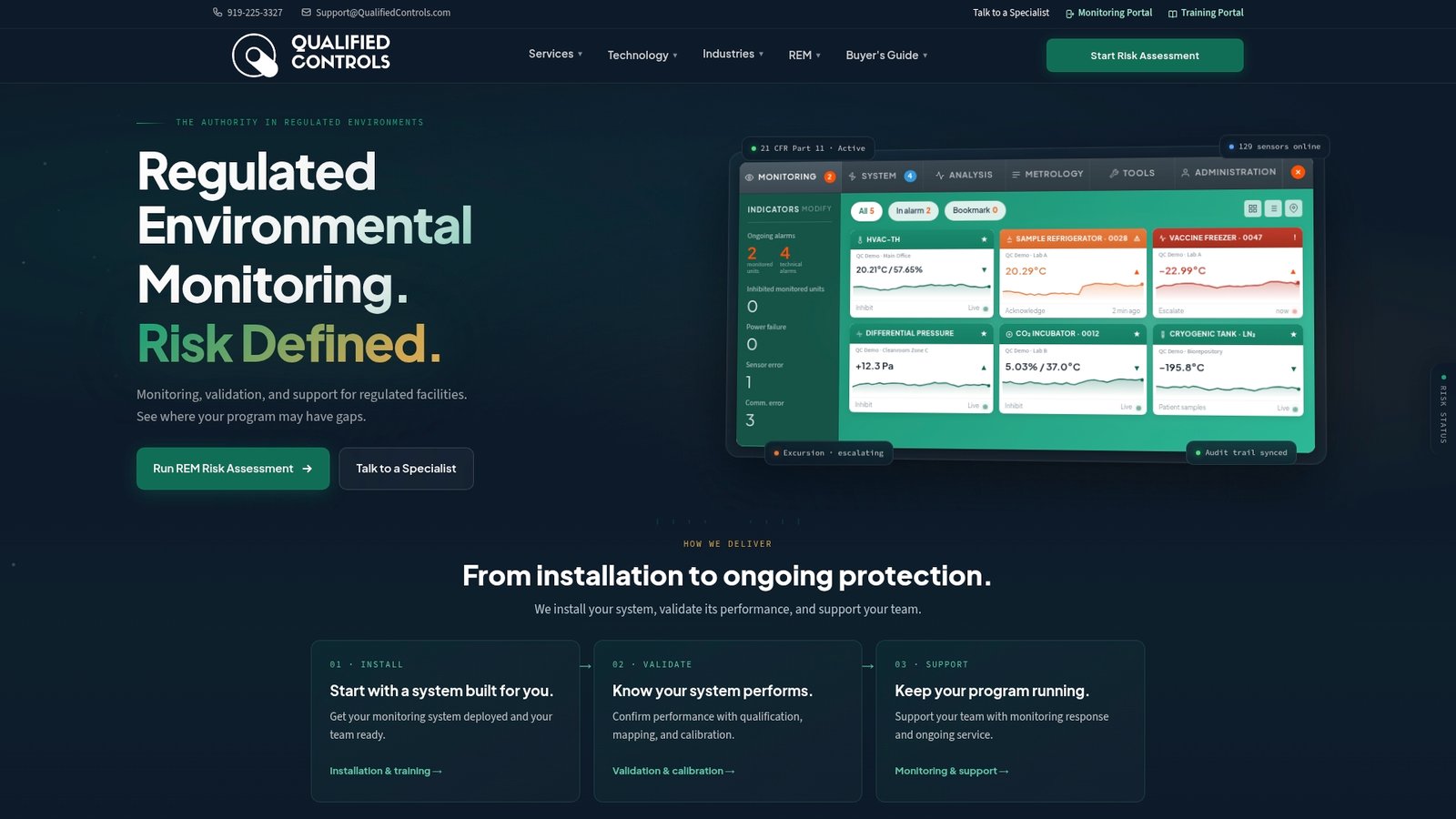
To see how the sensors, software and services fit your facility, explore the monitoring technology or contact us through qualifiedcontrols.com.
FAQ
What is laboratory environmental monitoring?
It is the continuous measurement and documentation of conditions such as temperature, humidity, pressure and particles in laboratory spaces and equipment. The goal is to keep tests, samples and products within their qualified ranges and to prove it with traceable records. Alarms and trend reviews turn those records into early warnings.
What temperature and humidity should a laboratory maintain?
The FDA ORA Laboratory Manual describes 20 to 25 °C and 35 to 50% relative humidity as a comfortable working environment, depending on geographical area. Your own limits should follow the methods, instruments, reagents and regulations in your lab. Document the reasoning for each limit you set.
How often should laboratory temperature sensors be calibrated?
It depends on your quality system and the standards that apply. Examples from official sources include annual calibration against a traceable reference and six-month accuracy checks between calibrations, as in the New Zealand Blood Service guidelines. Define the interval in a written procedure and keep the certificates.
Which regulations apply to a research lab’s environmental compliance?
That depends on the work. Accredited testing labs typically work to ISO/IEC 17025, pharmaceutical labs to GMP and 21 CFR, and nonclinical studies to GLP, with 21 CFR Part 11 applying to electronic records and signatures within its FDA-defined scope, including applicable predicate-rule records and electronic submissions to FDA. Confirm requirements with your quality or regulatory lead and any sponsor or accreditation body.
Sources
- EDQM: OMCL management of environmental conditions
- WHO: Monitor and record environmental parameters and equipment parameters (LQSI)
- FDA ORA Laboratory Manual, ORA-LAB.5.3
- WHO TRS 961 Annex 9: Temperature and humidity monitoring systems for fixed storage areas
- WHO: How to temperature map cold chain equipment and storage areas
- New Zealand Blood Service: Refrigeration Guidelines
- US EPA SOP EQ-02-10
- US EPA SOP QC-05-11
- ISPE Good Practice Guide: Controlled Temperature Chambers, 2nd Edition
- ASHP Pharmacy Environmental Monitoring Implementation Toolkit
- PDA Midwest: 2020 Revision of TR #13
- Australian Food Cold Chain Logistics Guidelines (2017)
- AIG: Reefer Container Climate Controlled Transport Recommendations