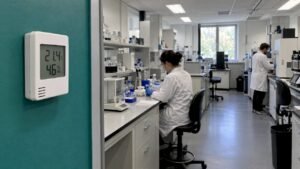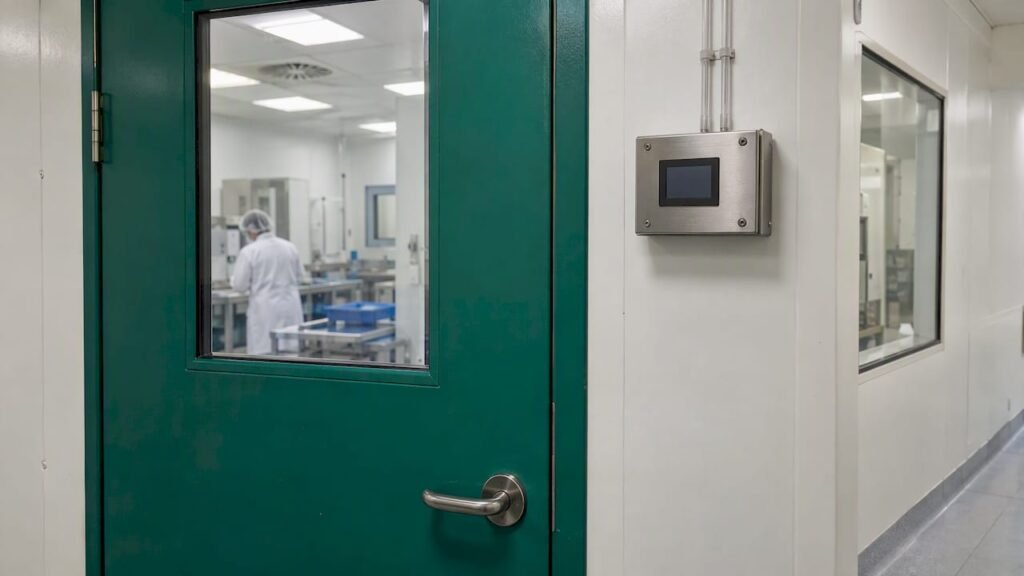
Cleanroom pressure monitoring is the continuous measurement of the pressure difference between a cleanroom and the spaces around it, with alarms and records that prove the difference held. Air then moves from cleaner areas toward less clean ones, and contamination does not travel the other way. A sound program has four parts: a defined pressure cascade, accurate and calibrated sensors, alarm settings tied to your own recovery data, and records that an inspector can trace without gaps.
TL;DR
- Monitor the pressure difference between each classified room and its neighbor, not a single room against the outdoors. The cascade is what protects the product.
- For aseptic processing, the FDA recommends at least 10-15 Pa between adjacent rooms of different classification, with doors closed. Other applications set their own values.
- Choose instruments with accuracy around ±0.25 Pa, calibrate them, and protect zero settings from tampering.
- Set alert and alarm thresholds and delays from commissioning data such as door-opening and recovery tests, then document every excursion.
- Treat the validated environmental monitoring system as the system of record, with local displays showing its value.
Table of Contents
- What cleanroom pressure monitoring is and why differential pressure matters
- How a pressure cascade works
- What pressure differentials to target
- Choosing, placing and calibrating sensors
- Alarms, excursions and recovery
- Pressure alongside temperature, humidity and the BMS
- Our perspective
- Validating the monitoring system
- A practical checklist before you buy
- Where Qualified Controls fits
- FAQ
- Sources
What cleanroom pressure monitoring is and why differential pressure matters
A cleanroom protects a process or product by controlling the air around it. Filtration cleans the air, and pressure decides where that air goes. When a cleaner room sits at a higher pressure than the room next to it, any leakage at doors, gaps and pass-throughs flows outward from the clean space. When that pressure relationship collapses, for example because a door is propped open or a fan slows down, air can carry particles and microorganisms into the room you are trying to protect.
This is why monitoring focuses on differential pressure, the difference between two adjacent spaces, rather than on absolute pressure. A differential pressure transmitter or room monitor continuously measures the difference between the clean room and the anteroom, and the reading is compared with limits that reflect the room’s classification and purpose.
In some facilities the logic is reversed. Rooms handling hazardous drugs or infectious material are held at negative pressure relative to their surroundings so that contaminants stay inside. The monitoring principle is identical: measure the difference, alarm on deviation, keep the record.
How a pressure cascade works
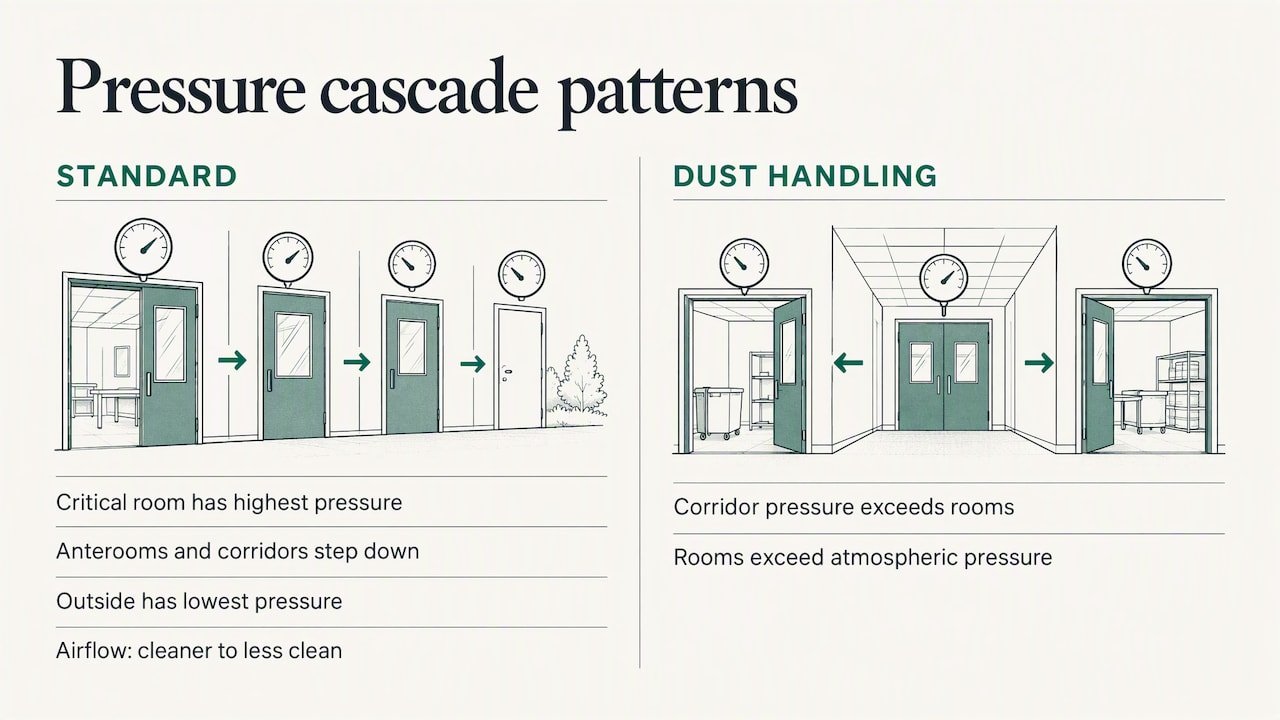
A cascade is a planned ladder of pressures. The most critical room sits at the top, anterooms and corridors step down in order, and the outside of the suite sits at the bottom. The WHO guidance on HVAC for GMP facilities states that airflow should move from cleaner to less clean areas, and that differentials between rooms should be assessed individually for the products handled. The same document notes that where dust is liberated, the corridor is typically kept at a higher pressure than the rooms, which in turn are above atmospheric pressure, so the cascade is not always a simple one-way staircase.
The building matters as much as the fan. The NIH Office of Research Facilities explains that door gaskets, airlocks and low wall leakage are what allow the HVAC system to hold pressure control at all. Monitoring cannot compensate for a leaky envelope, but it will show you where the envelope fails.
Which pairs of spaces to monitor
Monitor every boundary where a pressure relationship protects something:
- Each classified room against its anteroom or airlock.
- The anteroom against the corridor.
- The corridor against the uncontrolled space or the outdoors, where the cascade depends on it.
- Negative-pressure rooms (hazardous compounding, isolation, storage of hazardous drugs) against their adjacent areas.
Monitoring only the innermost room can hide a problem upstream. If the anteroom loses pressure, the room’s own reading may look acceptable for several minutes while the margin that protects it is already gone. Monitoring the whole cascade shows the gap as it forms.
What pressure differentials to target
There is no single number. Limits depend on the application, the regulator and your own risk assessment. The reference points below come from published guidance.
| Source | Application | Reference value |
|---|---|---|
| FDA aseptic processing guidance | Sterile drug products | At least 10-15 Pa between adjacent rooms of differing classification, doors closed |
| ASHRAE (compounding pharmacies) | Nonhazardous buffer rooms and anterooms | +0.020 in. w.c. relative to adjacent areas |
| ASHRAE (compounding pharmacies) | Hazardous buffer and storage rooms | −0.010 to −0.030 in. w.c. relative to adjacent areas |
| WHO TRS 1010 Annex 8 | GMP facilities | Assessed per room, based on products handled |
Two practical points follow. First, US sites often work in inches of water column while European and WHO documents use pascals, so configure your monitoring system in the unit your specifications use and make sure the audit trail records which one. Second, the number in a guideline is a floor for design, not a substitute for your own justification. Write down why each room’s setpoint was chosen, because that rationale is what an inspector asks for first.
Choosing, placing and calibrating sensors
Selecting the instrument
Cleanroom differentials are small, so range and accuracy deserve attention. ISPE advises that instrument ranges should not extend far beyond the required operating range and that accuracy of ±0.25 Pa is a sensible selection target. A transmitter with a very wide range will read noisily at 10 Pa, and that noise then turns into nuisance alarms.
Beyond the sensor itself, specify:
- A local display at the door so staff can see the room status before entering.
- Local and remote alarm outputs.
- Data storage or buffering if the network drops.
- Electronic records with timestamps, user attribution and audit trails.
Placement
Place sensing ports where they measure the room, not a local disturbance. Avoid spots directly in a supply air stream, next to a door swing or close to a return grille. Keep reference tubing short and protected, and use the same reference point consistently so that readings are comparable across rooms. Record the position in your drawings, because moving a port later changes the reading and should go through change control.
Calibration and zero checks
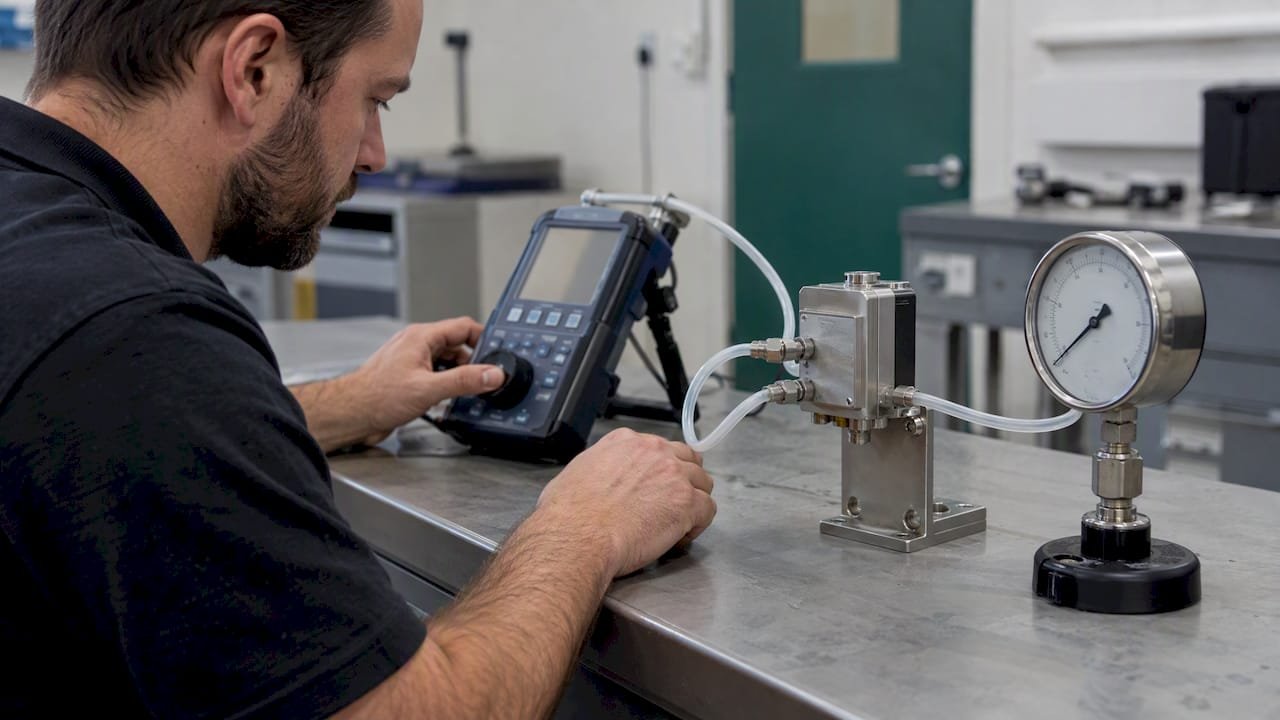
The WHO states that pressure control and monitoring devices must be calibrated, and that zero settings on gauges should be tamper-proof and checked at regular intervals. For differential sensors, drift at zero is the most common source of false confidence, so build a zero check into your routine and document it. Use a calibration provider whose reference standards are traceable, and schedule the work so that a calibration event does not leave an unexplained gap in the record. Our guides on validating sensors in regulated labs and on a data logger calibration service plan cover the same discipline for other parameters.
Alarms, excursions and recovery
Alert and alarm thresholds
An alarm that triggers on every door opening teaches staff to ignore it. An alarm that is too slow lets a real loss of protection go unnoticed. ISPE’s guidance says a well-commissioned HVAC system should hold room pressure within ±2.5 Pa. It also suggests an alert outside that band and an alarm when pressure deviates from setpoint by 5 Pa or more for a predetermined period.
Delays
The delay before an alarm is reported should come from data. ISPE notes that delays are typically set to less than 10 minutes, supported by impact studies such as recovery tests and door-opening simulations. In practice that means you open the door under controlled conditions, measure how long the cascade takes to recover, and set the delay just above normal recovery. The test report becomes the justification in your validation file.
Local and remote notification
The NIH technical bulletin requires that each classified space have a differential pressure monitor that provides local and remote alarms when pressure passes adjustable thresholds and durations. Local alarms tell the person at the door. Remote alarms reach someone who can act when nobody is in the room, such as overnight or on weekends. Define who receives each escalation level and what they do. Our articles on reducing alarm fatigue and on governance and escalation workflows apply directly.
Documenting an excursion
For each excursion, your record should show:
- The time the reading left the limit and the time it returned.
- The size of the deviation and the rooms involved.
- The alarm, who acknowledged it and when.
- The likely cause, such as a door left open, a filter loading issue or a fan fault.
- The product or activity impact assessment and any corrective action.
Electronic signatures and an unalterable audit trail make this far easier to defend than paper logs or handwritten notes. The structure matches what we recommend for excursion response planning.
Pressure alongside temperature, humidity and the BMS
Pressure is rarely monitored alone. Temperature and humidity affect comfort, product stability and particle behavior, and a failure in the air handler often shows up in all three at once. Monitoring them on one platform means one timeline, one alarm policy and one set of records, which makes root-cause analysis faster. Our piece on laboratory monitoring beyond temperature explains how to scope those parameters, and CO2 sensing for air conditions adds another layer in occupied spaces.
The relationship with the building management system needs a clear decision. The NIH recommends that room pressure monitors display the value from the validated environmental monitoring system, which serves as the system of record. The BMS controls the air handlers. The monitoring system independently observes and documents the result. Keeping the two separate means a fault in the control system cannot also erase the evidence.
Our perspective
Most pressure problems we see are not sensor failures. They are gaps between systems: an alarm nobody owns, a calibration that interrupted the record, a threshold copied from a template rather than from the room’s own recovery data.
We design monitoring as a managed service because the sensor is only one part of compliance. Continuous coverage of pressure, temperature and humidity, real-time alarms, electronic signatures and ALCOA+ record integrity are meant to work together, and installation, validation, calibration and support are meant to keep them working after go-live.
Our approach is proactive: identify weak points in the cascade and in the alarm chain before an excursion turns into an audit finding. That is the reason we pair the monitoring platform with IQ/OQ/PQ validation and audit support rather than leaving those steps to the customer.
the author
Validating the monitoring system
A pressure monitoring system in a regulated facility is itself a validated system. Expect to document installation qualification (are the right devices installed where specified), operational qualification (do alarms fire at the set thresholds and are records complete) and performance qualification (does it perform in real operation). Test the alarm path from sensor to the person who receives it, including after-hours escalation. Our FDA validation guide for IQ, OQ and PQ explains the sequence, and change control and revalidation triggers tells you what to revisit when a room is reclassified or a sensor is replaced.
For new construction, plan monitoring early. Sensor ports, cable routes and network coverage are far cheaper to include before walls close, as described in our guide to monitoring validation for new hospital wings. Compounding areas have their own requirements, covered in monitoring systems for pharmacies.
A practical checklist before you buy
- Do you have a written pressure cascade diagram with a setpoint and rationale for every boundary?
- Does the instrument range and accuracy suit your lowest setpoint?
- Are alarm delays based on documented recovery and door-opening tests?
- Does the system keep records during a network outage?
- Are electronic signatures, audit trails and user permissions validated?
- Is calibration scheduled and traceable, with a plan to avoid gaps in data?
- Who receives alarms at 2 a.m., and what are they expected to do?
Where Qualified Controls fits
If you manage a hospital, pharmacy, laboratory or pharmaceutical suite and want pressure, temperature and humidity monitored under one validated system, we can scope it with you. Our offering covers sensors from the MySirius, LoRa SPY, Nano SPY and Nova SPY lines, plus installation, training, IQ/OQ/PQ validation, ISO 17025 calibration, 24/7 monitoring response and audit support through our services.
Published subscription pricing on our pricing page is $4,500 per year for Initial, $12,500 per year for Serenity and $22,500 per year for Advanced. Enterprise pricing is arranged with us directly. Support tiers are described on our support page.
FAQ
What is the typical pressure differential for a cleanroom?
It depends on the application. For aseptic processing, the FDA recommends at least 10-15 Pa between adjacent rooms of different classification with doors closed. Compounding pharmacy guidance from ASHRAE uses different values for nonhazardous and hazardous rooms, and WHO asks for room-by-room assessment. Confirm which standard your inspector applies.
How accurate should a cleanroom pressure sensor be?
ISPE advises selecting instruments with accuracy within ±0.25 Pa and a range that does not extend far beyond the operating range. A sensor that is too coarse for your setpoint produces noisy readings and false alarms. Calibration and regular zero checks keep that accuracy in service.
How long should the delay on a pressure alarm be?
ISPE notes that delays are typically under 10 minutes and should be supported by recovery and door-opening data. Set the delay slightly above your normal recovery time so that routine entries do not alarm but a real loss of pressure does.
Should pressure monitoring be separate from the building management system?
The NIH recommends that local pressure monitors display the value from the validated environmental monitoring system, which serves as the system of record. The BMS controls the air handling, while the monitoring system independently documents the outcome. That separation protects your records if the control system fails.
Sources
- NIH ORF, APF Pressurization Part I technical bulletin (2019)
- WHO TRS 1010, Annex 8: HVAC for GMP (2018)
- ASHRAE, HVAC Design of Compounding Pharmacies
- ISPE, Room Differential Pressures in Facility Design (2024)
- FDA, Sterile Drug Products Produced by Aseptic Processing guidance
- DwyerOmega, How Important is Differential Pressure in Clean Rooms?