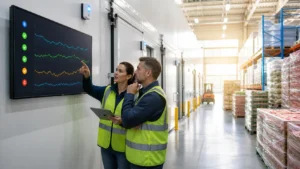
Temperature alarms move fast. Your quality system may not. For GMP facilities, that gap can leave a temperature event sitting in an email, text alert, or handwritten note without a complete, reviewable quality record. We help teams connect continuous monitoring data to controlled QMS deviation workflows so the response is timely, traceable, and ready for review.
A temperature monitoring API integration is not about turning every alert into paperwork. It is about setting clear rules for when an event needs immediate action, when it needs QA review, and when it must become a formal deviation.
Turn Excursions Into Controlled Quality Events
A temperature excursion can affect more than the room itself. In a stability chamber, cold room, warehouse, cleanroom, or controlled storage area, an out-of-range condition may affect product, raw materials, samples, or a validated process.
The correct response depends on the full context. We recommend considering the monitored asset, the approved range, how long the temperature was out of range, what was stored in the area, and whether the condition could affect quality.
An alert and a deviation are not the same thing. An alert may tell Facilities, Engineering, or an on-call team that a door was left open or refrigeration needs attention. A deviation is a controlled quality event that requires documented assessment, investigation, approvals, and closure.
With API-enabled monitoring, qualified event information can move from the monitoring platform into the QMS when approved criteria are met. This gives investigators a cleaner starting point and reduces the need to copy timestamps, readings, and alarm details by hand.
Define the Boundary Between Alarms and Deviations
Not every alarm should automatically create a deviation. If every small warning becomes a formal record, QA can be buried in low-risk events. On the other hand, handling a significant excursion only through phone calls or email may leave little evidence that product impact was assessed.
Before configuring an integration, we recommend that your quality team define event categories and approved response paths. Common categories include:
- Warning conditions approaching a limit
- Critical out-of-range alarms
- Sensor or communication failures
- Repeated short-duration excursions
- Events during unattended periods
Each category should have a named owner, an escalation path, and a clear documentation requirement. Your rules may also account for the amount of time outside the approved range, the time since the last acceptable reading, the type of equipment involved, and the materials stored in that location.
Consider a cold room that briefly moves toward its upper limit. Facilities may inspect the door seal, refrigeration unit, or loading activity and return the room to range quickly. If the event lasts longer, affects released materials, or repeats over time, QA may need to open a deviation, perform a product impact assessment, and determine whether CAPA is appropriate.
That risk-based boundary helps your team stay responsive without creating alert fatigue or weakening quality oversight.
Build an API Workflow That Preserves Data Integrity
A temperature monitoring API integration should transfer useful event data without changing the original monitoring record. The monitoring platform should remain the source of truth for the complete environmental history, while the QMS manages the deviation process, investigation, approvals, and closure.
The QMS deviation record should receive enough detail for a reviewer to understand what happened without relying on a short email summary. We typically recommend mapping items such as:
- Asset name, area, or monitored location
- Sensor identifier and parameter measured
- Approved limits and actual readings
- Excursion start and end times
- Alarm acknowledgments and user actions
- A link or reference to the full event history and audit trail
For regulated manufacturers, the workflow should support applicable 21 CFR Part 11 controls, including §§ 11.10(c), 11.10(d), and 11.10(e), for record retrieval, secure access, and time-stamped audit trails. A simplified summary alone may not give QA enough context to assess the event properly.
Controlled field mapping matters here. For example, the monitoring system may create a deviation draft only after a preapproved critical-event rule is met. The QMS can then assign the deviation number, route the record to QA, manage investigation approvals, and control final closure. This division reduces duplicate records and helps prevent uncertainty about which system owns each part of the process.
We also recommend placing the integration design under change control. QA and Validation should approve intended use, data mapping, exception handling, security controls, and test requirements before the workflow goes live.
Route Confirmed Events Through Investigation and CAPA
Once a confirmed event reaches the QMS, the monitoring record should give investigators a reliable timeline. Rather than manually rebuilding the sequence, the team can review when the temperature first crossed a limit, when alerts were sent, when someone acknowledged the condition, when corrective action began, and when the area returned to range.
That timeline supports a better investigation, but it does not replace one. Quality still needs to determine whether affected product, samples, or materials remain suitable for use. The deviation record should document the assessment decision, supporting evidence, required approvals, and follow-up actions.
Monitoring history can also show whether an event was isolated or part of a larger pattern. Repeated temperature drift, recurring door-open events, compressor cycling problems, or sensor communication interruptions may point to equipment or process issues that deserve further review. Predictive alerts can help identify equipment trending toward failure before a critical excursion occurs.
CAPA should follow the investigation, not the alarm alone. A one-time event with a known cause and effective correction may not require a full CAPA. Repeated excursions, failed corrective actions, maintenance gaps, or training concerns may call for additional actions, effectiveness checks, revised procedures, or equipment service.
Validate and Plan Before Year-End Audits
Connecting a monitoring platform to a QMS changes the regulated data workflow. We recommend starting with intended-use requirements that define which events create QMS records, which fields transfer, who can configure rules, and what happens if a message fails. Risk assessment, configuration specifications, test scripts, and documented approvals should follow.
IQ, OQ, and PQ testing should confirm the approved software and connection configuration, verify field mapping and event triggers, test permissions and audit trails, and confirm that failed messages or duplicate events are handled correctly. API updates, software upgrades, revised thresholds, new monitored assets, and QMS workflow changes should also go through change control to maintain the validated state.
As fall planning begins, map your current process from alarm to closure. Identify where teams still rely on email, phone calls, spreadsheets, paper forms, or manual QMS entry. A cross-functional review involving QA, Validation, Facilities, IT, and Engineering can clarify deviation criteria, security needs, support responsibilities, and testing expectations before year-end audit activity and change-control windows become tighter.
Turn Alarm Data Into Controlled Deviations
Qualified Controls can help you assess whether temperature monitoring API integration can route alarm evidence, timestamps, and audit-trail data into your QMS workflow. Our team supports validated monitoring architectures that reduce manual transcription while preserving the records QA needs for investigation and closure. Build a clearer path from excursion detection to documented corrective action before your next validation or audit cycle.