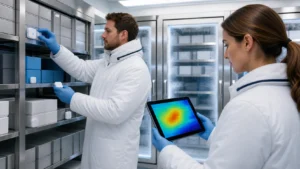
A freezer display tells you the temperature at its sensing point. It does not, by itself, describe conditions on every shelf, behind a loaded rack or near the door. Freezer temperature mapping helps your team evaluate that distribution under defined operating conditions and decide how the usable storage space should be managed.
For an existing freezer, the first question is what the study needs to establish. Are you reviewing a changed load pattern, investigating uneven performance, qualifying equipment for a new use or assessing the effect of a repair? A useful mapping proposal connects that question to a documented protocol, an operating plan and deliverables your quality team can evaluate.
Mapping and routine monitoring serve different purposes. A mapping study characterizes conditions across the equipment during a defined period. Routine monitoring follows selected locations over time. Neither should be presented as a substitute for the other where both are needed.
What should a freezer mapping study establish?
Start by defining the intended use of the freezer and the storage requirements of its contents. Those requirements provide the basis for the study’s acceptance criteria. A generic statement that a freezer is “cold enough” cannot tell you whether the proposed storage configuration is suitable.
The protocol should identify the unit, the storage volume being evaluated, the operating setpoint and the conditions the study will cover. It should also explain how measurements will be collected and assessed. The relevant locations and operating states depend on the equipment, its use and the question being investigated.
A useful study can help answer questions such as:
- How does temperature vary across the defined storage volume?
- Which locations show the warmest or coldest conditions during the study?
- How does the unit behave during the loading and access conditions included in the protocol?
- What operating restrictions or further investigations do the results support?
- Where should routine monitoring probes be placed, and what is the rationale?
These are questions to agree before testing. Results should be compared with approved criteria, rather than choosing criteria afterward to fit the results. QC’s mapping and qualification services provide a starting point for discussing that scope.
Planning to run the study with your own team? Qualified Controls offers mapping equipment rental with an included protocol to guide your mapping activities following applicable ISPE guidance. Rentals are available to existing QC customers and organizations new to Qualified Controls. If you prefer QC to perform the study, explore our mapping and qualification services.
How should you prepare an existing freezer?
Bring together its service history, current use and available temperature records. Record the equipment identifier, manufacturer and model, location, setpoint, shelving arrangement and normal loading pattern. Include known changes since the previous study, if one exists.
Review unresolved maintenance issues and excursions with the people responsible for the equipment and stored material. Damaged seals, unusual frost accumulation or inconsistent performance may need investigation. A study can support an investigation, but a passing result under one set of conditions does not repair an equipment fault or resolve every concern about future use.
The sequence of maintenance, investigation and qualification should be a documented decision. Do not assume that every older freezer should be replaced, that every problem requires the same study, or that collecting several months of monitoring data is a prerequisite for mapping. Available data can inform the plan; required qualification should not be deferred simply to build a longer trend.
Assign one person to coordinate access and scheduling. That person should know who can authorize changes to the freezer, who owns the contents and who will review the final report. Resolving those responsibilities early prevents a technician from arriving to find that nobody can approve the planned work.
How will stored material be protected during the work?
An occupied freezer needs an operating plan as well as a measurement plan. Decide whether material will remain in place, move to suitable alternative storage or be represented by an agreed load configuration. Document how the selected arrangement relates to the intended use of the equipment.
Any challenge that could affect stored material needs explicit review. Door-opening, power-interruption or other challenge tests are not instructions to experiment on a working freezer containing valuable inventory. Include only the tests justified by the approved protocol, with appropriate authorization and protection arrangements.
Confirm who will monitor the equipment during the study and who will respond if conditions depart from the agreed limits. Address access restrictions, out-of-hours work and what happens if testing must stop. The plan should explain how the freezer will be returned to its intended operating state and who authorizes that return.
What should you ask about the instruments and protocol?
Ask the provider to explain the proposed measurement locations and why they fit your freezer. A sensor count copied from an unrelated unit is not a sufficient rationale. The plan should account for the defined storage volume, layout and study objectives without assuming that every freezer needs the same arrangement.
The instruments should be suitable for the temperatures being measured. For QC equipment, use the model-specific specifications and user guides in our Resources & Documentation library to review the proposed hardware. Product documentation supports equipment selection; it does not replace the study protocol or instrument-specific calibration evidence. Ask how instrument identity, calibration evidence, recording intervals and time alignment will be documented. A diagram or photograph should make the locations understandable to a reviewer who was not present during setup.
Study duration and operating states also need a rationale. A short period that misses relevant operating behavior may not answer the intended question; a longer study is not automatically better if the conditions are poorly defined. Ask what the proposed window captures and what it leaves outside the scope.
For an ultra-low application, ask for the technical basis behind the proposed setup. A provider should be able to explain how the plan accounts for the particular unit, its intended loading and the range being assessed. A template can organize the work, but your approved requirements determine whether it is suitable.
What should you receive beyond a summary graph?
A report should let your team understand what was tested, what happened and how the conclusion was reached. Agree the deliverable package in the proposal so that a visually polished chart does not become the only record of the work.
Request a clear description of:
- The approved protocol and any authorized changes made during execution.
- Equipment identity, load configuration and measurement locations.
- Instrument identifiers and the associated calibration documentation.
- Study dates, recording intervals and recorded operating events.
- Data files and an explanation of any missing or excluded observations.
- Results assessed against the agreed acceptance criteria.
- Deviations, limitations, recommendations and review responsibilities.
Ask which file formats you will receive and how your team will access them later. If a conclusion depends on a particular event or location, the supporting evidence should be identifiable. Resolve questions about raw data, report revisions and final approval before the project closes.
How should mapping results affect everyday monitoring?
Use the findings to review routine probe locations, storage restrictions and operating instructions. A location chosen because it was convenient to install may not represent the conditions your team needs to follow. Record the reason for the final placement and retain its connection to the study.
Ongoing refrigerator and freezer temperature monitoring then provides a record at the selected locations. Review that record alongside equipment use, maintenance and documented events. Routine data can reveal changes that warrant investigation; it cannot establish the temperature at every unmeasured location.
The monitoring workflow also needs clear alarm ownership and a way to retrieve relevant records. When evaluating MySirius monitoring software, discuss those needs alongside the sensors and installation. The useful outcome is a measurement program people can operate and review, not a report stored separately from day-to-day decisions.
When should changes trigger a review of the study?
Changes in use can matter even when the freezer itself has not been replaced. Review the potential impact of relocation, repairs, shelving changes, different load arrangements, a new operating range or recurring unexplained excursions. A documented assessment should determine whether the existing evidence remains suitable and what further work is needed.
Avoid assigning one universal re-mapping interval to every application. Follow the facility’s requirements and approved review process, including any applicable periodic qualification arrangements. QC’s discussion of change control and revalidation triggers offers related context for organizing that assessment.
What information makes a mapping quote useful?
Send prospective providers the freezer model, location, intended use, operating range and reason for the study. Include current load information, relevant previous reports, known issues and restrictions on access or downtime. Identify the person who can approve the protocol and accept the deliverables.
Then compare proposals against the same questions: What will be tested? Why is the approach suitable? How will inventory be protected? What evidence will be delivered? Which decisions remain with your team? A lower price or larger sensor count alone does not answer those questions.
Freezer mapping is most useful when its scope connects the equipment, the stored material and the decisions your team must make. Qualified Controls can help you discuss that scope alongside qualification and ongoing monitoring. Contact us to plan a freezer mapping review with your equipment details and the question the study needs to answer.