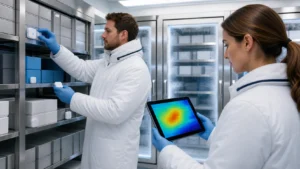
Rethinking Refrigerator Safety in Today’s Pharmacies
Refrigerator temperature mapping sounds technical, but it affects something very simple: whether the doses in your pharmacy fridge are actually safe to give. When late-summer heat hits and lines for back-to-school vaccines stretch to the door, many teams glance at the fridge display, see 2 to 8 degrees Celsius, and feel confident. The problem is that tiny screen only shows what is happening in one place, not across every shelf and drawer.
Inside that same fridge, the top shelf might be warm, the back corner might be freezing, and the door bins might swing up and down all day. All of those changes can affect vaccines, biologics, and other temperature-sensitive products. Traditional spot checks and basic data loggers only catch part of the story. True refrigerator temperature mapping helps you see the whole picture before there is a product loss, a revaccination effort, or a hard question from an inspector that you cannot easily answer.
At Qualified Controls we see pharmacies that care deeply about patients but are often working from assumptions instead of evidence. Our goal is to help shift this thinking so cold storage is based on real data, not wishful trust in a single number on a digital display.
What Temperature Mapping Really Reveals Inside Your Fridge
Refrigerator temperature mapping is a structured study, not just a quick check. In simple terms, it means placing several sensors in planned locations inside a unit and recording temperatures over time. Instead of one reading in one spot, you get a full picture of how that refrigerator behaves during normal and stressed conditions.
A mapping study usually looks at:
- Multiple locations, like top, middle, bottom, front, back, and door
- Temperatures over several days, not just an hour or two
- How door openings, restocking, and busy periods change the temperature
- How defrost cycles and ambient room heat affect the inside of the unit
When we compare this to a single probe or the factory display, the difference is clear. That single point might sit in a calm, protected zone while the front of the top shelf swings several degrees higher and lower throughout the day. Mapping often reveals warm spots near lights or doors, cold pockets near cooling plates, and layering between upper and lower shelves.
Real-world mapping should also include stress conditions, such as:
- Heavier loading with more vaccine boxes
- Frequent door openings during weekend clinics or after-work rushes
- Higher room temperatures in late-summer afternoons
The goal is not just to stamp the unit as pass or fail. The real value comes from the insights: which shelves are safest for your most sensitive products, which areas should be “do not store” zones, and how you should set your alarms so they match known patterns inside the fridge.
Compliance Gaps Hiding Behind “Normal” Readings
Pharmacy teams work hard to follow CDC vaccine storage guidance and common accreditation standards. Many are told to keep refrigerated products between 2 and 8 degrees Celsius, use continuous monitoring, and document any excursions. On paper, this often looks like one buffered probe in each unit and a daily review of reports.
The gap appears when that single probe sits in the best part of the fridge. The door display and probe readings might look fine, yet parts of the same unit may drift outside the recommended range during hot weather or heavy use. This is especially common when:
- High-risk vaccines are placed in the door or near the light
- Units are fully packed with little room for airflow
- Staff hold the door open longer during rush periods
There are also paperwork issues that show up during audits, like:
- Old mapping reports from a different building or season
- No proof that mapping sensors were calibrated
- No clear logic tying mapping results to current probe placement
Inspectors are asking more pointed questions, such as how the pharmacy chose its monitoring locations and how it knows the whole unit, not just one spot, stays in range. Without solid mapping data, those questions can be uncomfortable, even when daily logs look normal.
Why Some Pharmacies Question Refrigerator Temperature Mapping
Many pharmacy leaders are cautious about refrigerator temperature mapping. We hear concerns like, “We are just a retail site, not a big hospital” or “The fridge came validated from the vendor.” There is also a belief that if there has never been a big temperature alarm or obvious failure, everything must be fine.
Other common worries include:
- It will be too complex or confusing to plan
- It will interrupt daily work or require empty units
- It will uncover problems that are expensive to fix
Vendor testing of “pharmacy-grade” refrigerators is helpful, but it happens under controlled conditions, not in your specific space. It does not include your actual loading patterns, your door-opening habits, your late-summer room temperatures, or the way your staff move between stations.
We see mapping not as a luxury project, but as a smart risk management step. It lets you prove that your existing setup works, shows where simple changes can lower risk, and supports clear decisions about when equipment truly needs an upgrade and when it just needs better use and monitoring.
Smarter Strategies for Refrigerator Temperature Mapping
A practical, pharmacy-friendly mapping plan does not have to be overwhelming. We think of it in five steps: plan, map, interpret, implement, and review.
Planning often includes:
- Choosing which units to map first, usually those with vaccines and high-value biologics
- Picking a time that reflects stress, such as late summer or busy clinic periods
- Setting clear criteria that match guidance and your internal policies
During the mapping itself, you would:
- Place calibrated sensors at top, middle, and bottom, front and back
- Run the study for several days during normal work, including peak traffic
- Capture door openings, restocking, and ambient room changes
Once the data is in, the key is to turn it into action. That might mean:
- Moving continuous monitoring probes to locations that reflect the highest risk
- Marking certain shelves or bins as “do not store” for sensitive items
- Adjusting loading patterns so boxes do not block airflow
- Setting alarm limits that make sense with observed variation
This is also not a one-time event. It is smart to repeat mapping after major changes like moving a unit, replacing it, or changing how the room is cooled. Results can feed directly into staff training, standard procedures, and quality improvement programs. Automated, real-time environmental monitoring systems, like the ones we provide at Qualified Controls, can then link those mapping insights to day-to-day oversight so you are not starting from scratch each season.
Turning Mapping Doubts Into Proven Protection for Patients
Pharmacy leaders who question refrigerator temperature mapping are often asking the right thing: is this effort worth our time? The better question might be, what do we truly know about temperatures in every part of our refrigerators, especially when the weather is hot and demand is high?
A quick internal review can be eye-opening. Look at which units have never been mapped, where monitoring probes sit right now, and whether your current practice would stand up to detailed questions from regulators, corporate quality teams, or concerned patients. From there, a structured mapping assessment that fits with your existing monitoring can bring clarity. At Qualified Controls, we focus on making that process practical, using sensors, software, and analysis that translate raw data into simple, usable steps.
In the end, refrigerator temperature mapping is about more than checking a compliance box. It protects product integrity, lowers waste, and helps show that your pharmacy goes beyond the bare minimum to guard every refrigerated dose. For patients who trust you with their health, and for teams who work hard every day, that peace of mind is worth building on real, proven evidence instead of assumptions.
Get Started With Your Project Today
If you are ready to verify that your cold storage performs as intended, we can help you plan and execute a compliant refrigerator temperature mapping study tailored to your facility. Our team at Qualified Controls will work with your staff to define objectives, select appropriate sensors, and develop a protocol that aligns with regulatory expectations. Reach out today so we can review your needs, outline a practical approach, and schedule your project on a timeline that fits your operations.