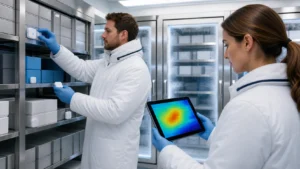
Refrigerator temperature mapping is not just a paperwork task. It is a control point that protects people, products, and your entire operation any time you store temperature-sensitive materials. When mapping falls behind, you not only risk equipment problems, you risk product integrity, compliance issues, and real impact on patients and customers.
As weather warms up, the risk grows. Higher ambient temperatures put extra strain on compressors and door seals. Small weak spots in your cold storage that did not show in cooler months can suddenly become hot zones. In this article, we will walk through what happens when refrigerator temperature mapping lapses, why mapping matters so much, and how modern monitoring can keep your cold storage on track all year long.
When Refrigerator Temperature Mapping Falls Behind
Refrigerator temperature mapping is the process of measuring and documenting how temperature behaves inside a unit over time. It shows where the hot and cold spots are, how fast temperature recovers after door openings, and whether the whole storage space stays within your required range.
When mapping lapses, especially heading into summer, several things tend to happen at once:
- Units run harder to fight higher ambient heat
- Weak gaskets, clogged vents, and overloaded shelves get worse
- Staff open doors more often in busy seasons
- Small drifts that were once harmless become real excursions
Those changes can lead to missed alarms, unknown temperature swings, and product stored in the wrong areas inside the unit. Without up-to-date mapping, you lose your guide for safe storage locations and alarm setpoints, which pushes risk onto your products and your compliance record.
How Temperature Mapping Protects Product Integrity
Refrigerator temperature mapping goes far beyond placing a single probe in the middle of a shelf. A proper study looks at how the entire space behaves.
Good mapping usually includes work like:
- Placing sensors throughout the unit, including corners and near doors
- Recording temperatures over several days in normal operating conditions
- Identifying hot and cold spots and dead zones
- Confirming which shelves and bins are appropriate for sensitive items
- Setting or adjusting alarm thresholds based on real data
For items like vaccines, biologics, blood products, lab reagents, and sensitive foods, even short temperature excursions can affect stability. Mapping helps support:
- Shelf life claims
- Product quality and potency
- Label directions for storage conditions
When the storage environment matches the data used to establish stability profiles, you can stand behind the product. When it does not, every temperature question becomes a quality question.
That is why ongoing verification is so important. Re-mapping should be considered when:
- Seasons shift from cooler to hotter weather
- Units are moved or replaced
- Shelving, loading patterns, or packaging change
- The facility layout or HVAC pattern changes
Without that follow-up, a once reliable refrigerator can slowly drift away from the conditions you originally validated.
The Hidden Costs When Mapping Is Neglected
When refrigerator temperature mapping falls behind, the cost often shows up suddenly during a deviation or audit.
Some common impacts include:
- Product loss when you cannot prove that inventory stayed within range
- Quarantined lots while teams hunt for missing or outdated mapping records
- Discarded materials stored near doors, vents, or walls that were never properly assessed
Once a temperature excursion or mapping gap is discovered, operations can quickly get disrupted. Teams may face:
- Emergency retesting of affected products, when possible
- Rush shipments to replace questionable stock
- Overtime for staff involved in investigations and extra documentation
- Production or clinic delays while decisions are made about product safety
There is also a trust cost. Regulators, customers, and patients expect that temperature-sensitive products are stored under tight control. When a facility cannot show solid mapping data, it suggests that other controls might be weak too. That doubt can linger long after the immediate problem is solved.
Compliance Fallout in Highly Regulated Environments
In regulated spaces like life sciences, healthcare, biotech, and controlled food storage, agencies expect that cold storage conditions are documented and controlled. Temperature mapping is a standard part of that picture for GxP materials and other critical items.
Common audit and inspection findings tied to mapping lapses include:
- Missing or incomplete mapping studies for active units
- Studies that are many seasons or configuration changes out of date
- Poor sensor placement that ignores likely hot or cold spots
- Lack of re-mapping after a unit was moved, repaired, or modified
When inspectors see these gaps, they may view them as signs of a broader quality system problem. That can lead to:
- Formal observations about temperature control and documentation
- Requests for extensive corrective and preventive actions
- Limits on product distribution until controls are proven reliable
- In serious cases, restricted operations or loss of key licenses
All of this can grow from something that started as a simple delay in updating refrigerator temperature mapping.
Why Manual Mapping Breaks Down in the Real World
Manual mapping and monitoring often look simple on paper, but real life gets in the way.
Human-driven processes run into issues like:
- Missed readings when staff are busy or short-handed
- Typos or wrong units entered in logs
- Inconsistent probe placement between studies
- Paper records that are hard to read or easy to misplace
When mapping is treated as a one-time project instead of part of an ongoing strategy, there is also a big blind spot. Between mapping events, you may only have spot checks or a small number of chart recorders. That leaves a lot of room for unseen excursions.
As organizations grow, the challenge multiplies. A single facility with a few refrigerators might manage with manual tools for a while. But add multiple sites, dozens of units, and complex storage rules, and it becomes very hard to keep everything aligned without automated help.
Turning Mapping Lapses Into a Modern Monitoring Strategy
The good news is that a lapse in refrigerator temperature mapping can be a turning point. It is often the moment when teams decide to move from reactive fixes to a more modern approach.
At Qualified Controls, we see mapping and real-time monitoring as two parts of the same system. Wireless sensors installed for mapping can stay in place to provide continuous data to cloud software. That link gives you:
- Ongoing verification that conditions still match your mapping study
- Automated alerts when thresholds are crossed, not hours later
- Trend views that show slow drifts, like a compressor working harder in hot weather
With managed services, you also gain expert help with:
- Study design and sensor placement based on your products and equipment
- Clear, audit-ready reports that show mapping methods and results
- Routine reviews of monitoring data to spot seasonal or usage patterns
When mapping and monitoring work together, you can head into summer, or any busy season, with far more confidence in your cold storage.
Get Started With Your Project Today
If you are ready to verify that your cold storage is performing the way it should, we are here to help you plan and execute a compliant study. Our experts will walk you through every step of refrigerator temperature mapping, from defining requirements to delivering clear, audit-ready documentation. At Qualified Controls, we focus on practical, data-driven solutions tailored to your facility and regulatory needs. Reach out to our team so we can discuss your timelines, equipment, and goals and move your project forward with confidence.