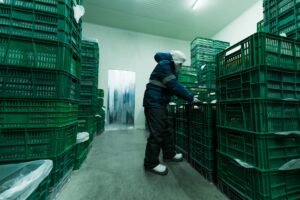
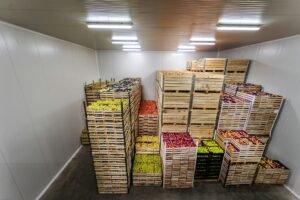
A cooler fails at 2 a.m. By the time someone opens the door at 7, the product is warm, the paper log shows a normal reading from the night before, and you have to decide what to throw out and what you can defend keeping. Most commercial food spoilage follows that pattern. It is rarely one dramatic event. It is a temperature drift nobody saw, a door left open during a delivery, or stock that sat at the back of a shelf past its date.
This guide covers how to prevent food spoilage in grocery stores, restaurants, commissaries and cold storage: what causes it, which temperature limits apply, how to catch refrigeration trouble early, how to rotate stock, and how to keep records that hold up in an audit.
What causes food spoilage in commercial cold storage?
Bacteria, mold and yeast cause most spoilage, and temperature controls how fast they grow. Three groups of causes show up again and again in stores and kitchens.
Temperature excursions
Cold units drift out of range for ordinary reasons: a failing compressor, an iced evaporator coil, a worn door gasket, a blocked fan, an overloaded case, or a long delivery with the door propped open. USDA’s Food Safety and Inspection Service describes 40°F to 140°F as the “Danger Zone” for consumers, the range where bacteria multiply fastest. Commercial rules are tighter and are covered in the next section.
Humidity and airflow
High humidity encourages mold and makes leafy produce slimy. Low humidity dries out produce and bakery items. Blocked airflow creates warm pockets inside a case or walk-in that a single thermometer by the door will never show.
Handling and rotation
Cross-contamination, open or damaged packaging, and poor rotation turn safe product into waste. Raw meat stored above ready-to-eat food, unlabeled prep containers, and new deliveries stacked in front of older stock are all preventable.
What temperature limits apply to food storage?
The FDA Food Code is a model code. Most state and local health departments adopt it, sometimes with changes, so your inspector enforces your jurisdiction’s version. The table lists the 2022 Food Code provisions that matter most for storage and cooling. Check your local code and your product labels for the limits that govern your site.
| Requirement | Limit | Source |
|---|---|---|
| Cold holding of time/temperature control for safety (TCS) food | 41°F (5°C) or less | FDA Food Code 2022, § 3-501.16(A)(2) |
| Shell eggs not treated to destroy all viable Salmonellae | Refrigerated equipment with ambient air at 45°F (7°C) or less | FDA Food Code 2022, § 3-501.16(B) |
| Cooling cooked TCS food | 135°F to 70°F within 2 hours, then to 41°F or less within a total of 6 hours | FDA Food Code 2022, § 3-501.14(A) |
| Frozen food | Stored frozen food must be maintained frozen | FDA Food Code 2022, § 3-501.11 |
| Consumer guidance | “Danger Zone” of 40°F to 140°F | USDA FSIS, “Danger Zone” (40°F – 140°F) |
The Food Code does not set a numeric frozen-storage temperature. Follow the storage temperature on the product label and in your supplier specification.
How do you prevent food spoilage in a grocery store or supermarket?
Prevent spoilage in a store by catching equipment trouble early, controlling how product is stored and rotated, and watching temperatures continuously rather than at scheduled checks.
What are the early signs of refrigeration failure?
Equipment usually gives warning before it fails. Watch for:
- New buzzing, clicking or louder compressor noise
- A compressor that cycles on and off more often than before
- Ice on coils, around gaskets or inside cases
- Frost around door seals, hinges and corners, which points to a seal that is no longer tight
- Water pooling near cases or inside walk-ins
- Product that feels warm, wilts early or sours before its date
- Warm spots in one part of a case and cold blasts in another, which point to an airflow problem
Our guide to grocery store refrigeration system breakdown signs covers each of these in more detail, including when to call a technician.
What are the best practices for retail food storage?
- Separate by risk. Store raw meat and poultry below ready-to-eat food, and keep dairy and meat in designated zones so juices cannot drip onto other product.
- Keep air moving. Leave space around products and away from fans and coils. Do not load past the load line in open cases.
- Label everything you repackage or prep. Include the product name and a use-by or discard date.
- Group by humidity needs. Keep leafy greens and other high-humidity items apart from dry goods and bakery.
- Check seals and gaskets on a schedule. A leaking seal changes both temperature and humidity.
- Clean on a schedule. Drains, coils, shelves and gaskets all collect residue that harbors mold and blocks airflow.
- Train staff on the why. People follow a rule more reliably when they know which failure it prevents.
How does the supermarket cold chain stay intact?
The cold chain is every handoff from supplier truck to shopper’s cart. Each handoff is a place to lose control of temperature:
- Receiving. Check product temperature at the dock, record it, and move chilled and frozen product into cold storage quickly. Do not leave pallets on a warm dock while paperwork is finished.
- Back-of-house storage. Walk-ins and freezers hold the most value in one place. A failure here costs the most.
- Stocking and display. Stock in small batches, monitor each case’s air temperature and keep product below the load line.
- Transport between sites. For product moving between stores, commissaries and distribution centers, temperature loggers in the vehicle or trailer fill in the gap.
How should restaurants and commissaries monitor food temperatures?
Restaurants and commissaries have two storage problems on top of the grocery list: cooling cooked food quickly, and holding hot and cold food between production and service.
Cooling is where kitchens most often fall behind
The Food Code limit is 135°F to 70°F within 2 hours, then to 41°F or less within a total of 6 hours (§ 3-501.14(A)). A common example: if chili reaches 70°F in 1.5 hours, you have 4.5 hours left to reach 41°F. Record the start time, the 2-hour reading and the final reading.
Walk-ins, reach-ins and holding units
Monitor every walk-in cooler, freezer, reach-in and prep-line unit, not only the large ones. Small units are opened constantly and fail often. For chains, the same sensors give a head office a view across all locations. Our guide to food quality control in fast food chains covers quick-service operations in depth, and our article on food temperature monitoring for dark kitchens covers delivery-only kitchens, where several brands share one cold room.
How do FIFO and FEFO reduce food waste?
FIFO (first in, first out) uses the oldest delivery first. FEFO (first expired, first out) uses the product with the earliest expiration date first, even if it arrived later. Use FEFO for anything with a printed date, such as dairy, deli, packaged meat and prepared food.
To make rotation work in practice:
- Put new stock behind or beneath existing stock, every time.
- Date-label all repackaged and prepared items.
- Pull short-dated product forward to a marked shelf or a markdown location before it expires.
- Walk each cooler weekly and remove expired product.
Temperature history adds a second rotation signal. A case stored near a busy dock door that ran warm has had a harder life than a case in a stable room, even if the printed dates match. Continuous records let you move the harder-lived stock first.
Records also reduce unnecessary discards. After a cooler alarm, a complete time-and-temperature log shows how long product was above a limit and which units were affected. That lets a trained person make a documented decision for the affected product instead of discarding the whole room “just in case.” Your food safety plan and local code decide what is acceptable. The log supplies the evidence.
What does continuous temperature monitoring add?
A manual check tells you the temperature at the moment someone looks. Nights, weekends and busy shifts go unrecorded, and a unit that drifts out of range at 2 a.m. and recovers by 6 a.m. never appears on a clipboard.
Qualified Controls wireless sensors measure temperature, humidity, door status and CO2 and send readings to the Qualified Controls monitoring platform. A temperature monitoring system gives you:
- Readings around the clock from walk-ins, freezers, reach-ins, display cases, dry storage and warehouse zones
- Alerts by text, email or app notification when a reading leaves its range, with escalation to a second person if the first does not respond
- Trend graphs that show a slow drift, longer recovery after defrost or a weakening compressor before it becomes a failure
- Battery-backed sensors that keep reporting through a power loss, so you have a record of the outage
Place sensors where the product is, not only where it is convenient. In a walk-in, that means the warmest likely spot near the door and at product level. In a display case, it means the air at the product, not the thermostat.
How do you prepare for a food safety audit with automated temperature records?
Auditors want evidence that temperatures stayed in range and that you acted when they did not. Which rules apply depends on your operation.
Retail and foodservice. Grocery stores and restaurants are generally inspected under state and local retail food codes based on the FDA Food Code. Confirm the requirements for your jurisdiction with your health department.
Food manufacturers, processors and cold storage warehouses. 21 CFR Part 117 sets current good manufacturing practice and preventive controls for human food. It applies to facilities that are required to register with FDA (§ 117.3). For those facilities, Subpart C requires written monitoring procedures with adequate frequency (§ 117.145(a) and (b)) and records of that monitoring (§ 117.145(c)). The records required to show implementation of the food safety plan include monitoring, corrective action and verification records, including calibration of monitoring instruments (§ 117.190(a)). Section 117.145(c)(2)(i) allows refrigeration temperature records for TCS food in storage to be either affirmative records or exception records showing loss of temperature control. Records must contain the actual values observed, be accurate and legible, and be created at the time the activity is performed (§ 117.305). Whether your site is covered, and which provisions apply, is a decision for your preventive controls qualified individual.
The Qualified Controls monitoring platform supports these record requirements. It stores timestamped readings, alert history and the user actions taken on each alert, and it produces reports by unit and date range. It does not replace your food safety plan, and no regulator certifies or approves a monitoring platform. You remain responsible for your procedures, your calibration schedule and your corrective actions.
Before an audit, confirm that:
- Every unit that holds TCS food has a sensor, a defined limit and a named owner for alerts
- Each excursion has a record of the response: what was done, by whom, and what happened to the product
- Sensor calibration or verification is current and documented
- You can pull a report for any unit and date range in minutes
For a HACCP-based plan, see our article on achieving HACCP compliance with real-time temperature monitoring.
How do you start? A 30-day checklist
- Week 1: List your units. Count every walk-in, freezer, reach-in, display case, prep cooler and dry storage room. Rank them by value of product held and by how often they fail.
- Week 1: Set limits. Write the alert limit for each unit from the Food Code, your local code and the product label.
- Week 2: Place sensors in the highest-risk units first. Test an alert end to end: trigger one and confirm the right person receives it.
- Week 2: Write the response. For each alert type, name who responds, what they check first and how long they have to move product.
- Week 3: Train the team on the alert process, FIFO/FEFO and labeling.
- Week 4: Review the data for units that run warm, recover slowly or alarm often, and schedule maintenance.
Food spoilage prevention FAQ
What is the best way to prevent food spoilage in a commercial kitchen or store?
Hold cold food at 41°F or below, cool cooked food within the Food Code time limits, rotate stock with FIFO or FEFO, separate raw from ready-to-eat food, and monitor temperatures continuously so a failure is caught while product can still be moved.
What temperature should commercial refrigeration be kept at?
The FDA Food Code requires TCS food to be held at 41°F (5°C) or less (§ 3-501.16(A)(2)). Untreated shell eggs must be in refrigerated equipment with ambient air at 45°F (7°C) or less (§ 3-501.16(B)). Your state or local code and your product labels may set different limits.
How fast do you have to cool cooked food?
From 135°F to 70°F within 2 hours, then to 41°F or less within a total of 6 hours (Food Code § 3-501.14(A)).
What are the signs a grocery store refrigeration system is failing?
Louder or changed compressor noise, frequent short cycling, ice on coils or gaskets, frost around door seals, pooling water, foggy display glass, uneven temperatures within a case, and product that spoils earlier than its date.
What is the difference between FIFO and FEFO?
FIFO uses the oldest delivery first. FEFO uses the product with the earliest expiration date first, regardless of delivery order. FEFO is the better rule for dated perishables.
Do automated temperature records satisfy a food safety audit?
They help meet record requirements when they hold actual readings, timestamps and corrective action history. For facilities covered by 21 CFR Part 117, monitoring must be documented under § 117.145 and implementation records kept under § 117.190. No regulator certifies a monitoring system, so keep your procedures, calibration records and corrective actions with the data.
How does temperature monitoring reduce food waste?
It shows an excursion while there is still time to move product, and it gives you a time-and-temperature record so a trained person can decide what is affected. It also shows which units run warm, so you can fix equipment and adjust ordering and rotation.
Get started
If you run a grocery store, restaurant group, commissary or cold storage facility, the first step is a list of the units that would hurt most if they failed tonight. See how Qualified Controls works with food and beverage operations, or contact us for a walkthrough of sensor placement and alert setup for your sites.