Temperature Monitoring for Wine and Spirits Storage
Wine and spirits are living investments. Whether you're managing a commercial cellar, a distribution warehouse, a retail back room, or a private collection, temperature and humidity control directly affects the quality, value, and drinkability of every bottle on your shelves.
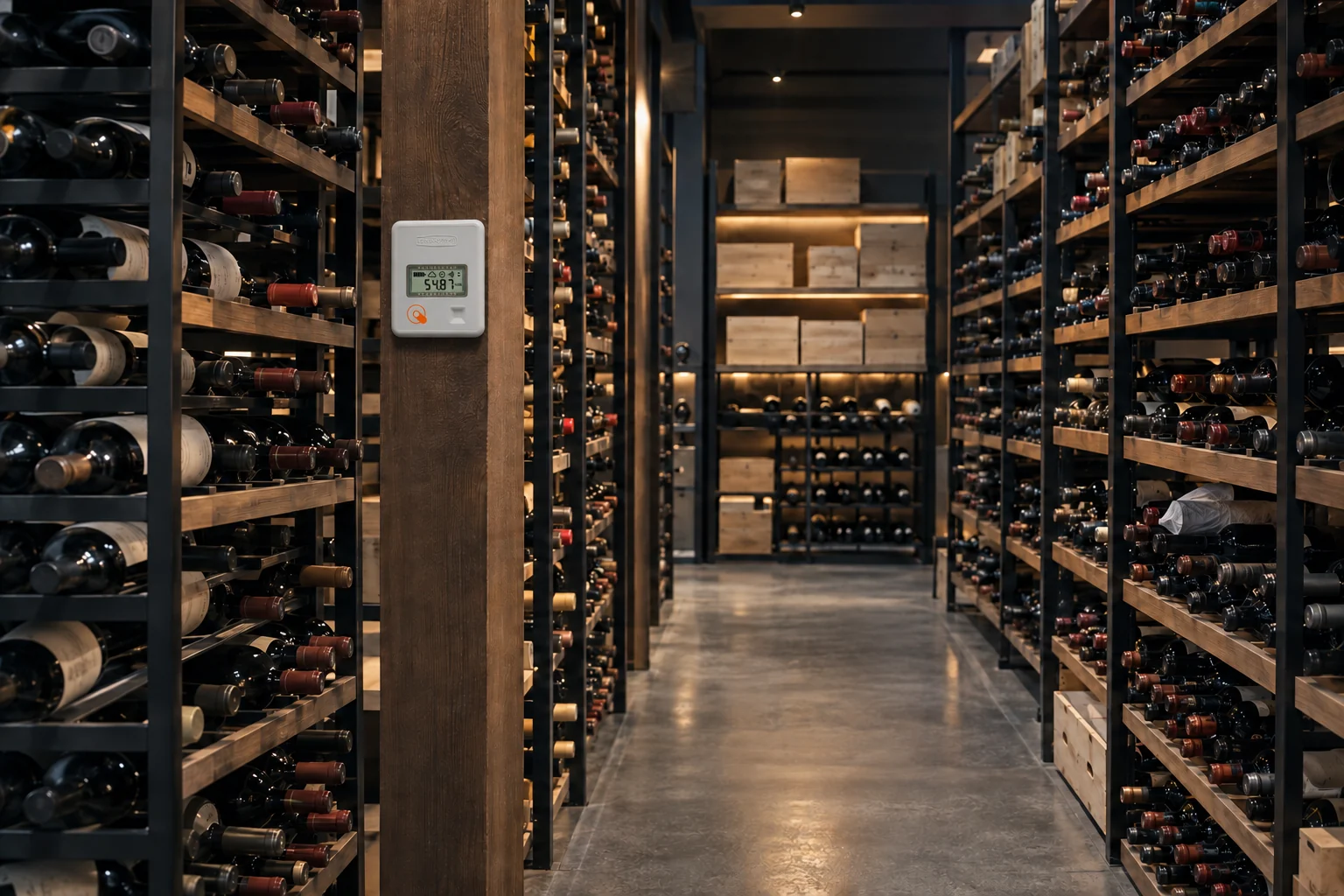
Why Temperature and Humidity Monitoring Matters for Wine and Spirits
Wine is one of the most temperature-sensitive products you can store. Unlike pharmaceuticals or vaccines, wine doesn't come with an expiration date tied to a compliance rule—but the science of deterioration is just as real.
Spirits are more resilient than wine but not immune to environmental stress. Extended heat exposure accelerates evaporation through the cork and can alter flavor profiles over time, particularly for barrel-aged products stored in bottle.
Monitoring gives you proof that your storage conditions are consistent—and gives you the warning you need to act before a problem becomes a loss.
Premature aging from sustained heat exposure
Consistent temperatures above the optimal range accelerate chemical reactions in wine, collapsing complexity and flattening flavors.
Flavor degradation and loss of aromatic complexity
Heat breaks down volatile compounds that create the nose and finish. Once lost, they cannot be recovered.
Cork failure caused by low humidity or temperature swings
Dry air shrinks corks; swings cause expansion and contraction. Either way, seals fail and oxygen intrudes.
Label damage and mold growth in high-humidity environments
Humidity above 75% promotes mold on labels and storage infrastructure; below 50%, labels deteriorate and corks dry out.
Oxidation from compromised closures
Once a cork or capsule fails, oxygen entry is inevitable. The wine oxidizes, turning brown and losing all character.
Financial losses on high-value inventory that can't be replaced
A single evening of unmonitored temperature excursion can destroy thousands of dollars in rare or aged bottles.
What Conditions Should You Target?
Storage Conditions Reference
The consistency matters as much as the number. A cellar that holds steady at 58°F year-round will outperform one that swings between 50°F and 68°F with the seasons. Our sensors track these fluctuations so you can spot problems early and verify that your HVAC and cooling systems are performing as expected.
How It Works
We place calibrated sensors in the zones that matter—inside cellars, wine lockers, barrel rooms, warehouse bays, walk-in coolers, and retail display areas. Sensors report temperature and humidity readings to a secure platform at regular intervals.
High-accuracy temperature and humidity sensors
Calibrated instruments placed at validated positions capture the precise conditions your wine and spirits require.
Real-time alerts by email, text, or app notification
When conditions drift, you know instantly. Alerts go to the people who can act, at any time of day.
Historical data logging with graphing and trend analysis
Every reading is stored. Review patterns, spot seasonal trends, and verify that improvements stick.
Cloud-based access from any device
Check your cellar from anywhere. No special software, no login friction—just log in and look.
Configurable thresholds for different storage zones
Not all areas need the same alert limits. Set thresholds that match your specific inventory and environment.
Battery-backed sensors that keep recording during power outages
When the power fails, your sensors stay alive. When power returns, data uploads automatically.
You get a complete picture of your storage environment, from live conditions to long-term trends. Whether you're checking conditions from the tasting room or reviewing last month's data before a client visit, the information is there.
Storage Condition Calculator
Find Your Monitoring Needs
How Monitoring Protects Your Investment
Protecting High-Value Inventory
Some bottles are worth more than equipment. Fine wines, rare vintages, and limited-release spirits represent significant financial value. A temperature excursion that damages even a small portion of a high-value collection can mean tens of thousands of dollars in losses.
Monitoring protects your inventory by:
- Catching HVAC failures and power outages in real time
- Alerting you to gradual temperature drift that signals equipment degradation
- Providing documented proof of storage conditions for insurance claims
- Creating a verified history that supports resale value and provenance
For collectors, auction houses, and storage facilities managing other people's wine, monitoring isn't optional—it's a responsibility. Our systems give you the documentation to back up your duty of care.
Alerts That Give You Time to Act
Wine damage doesn't happen in a single moment—it builds over hours of exposure to poor conditions. That window is your opportunity, but only if you know about it.
Our alert system delivers:
- Instant notifications when temperature or humidity crosses your thresholds
- Configurable escalation so the right person responds at the right time
- Alert acknowledgment tracking for accountability
- Weekend and overnight coverage so nothing goes unnoticed
A Saturday night HVAC failure in an unmonitored cellar could mean 48 hours of rising temperatures before anyone notices Monday morning. With our system, you know within minutes.
Historical Data and Reporting
Long-term storage means long-term data. Our platform keeps a complete record of every reading, every alert, and every response for as long as you need it.
Use historical data to:
- Review seasonal temperature trends in your storage spaces
- Verify that HVAC maintenance is actually improving performance
- Provide storage condition documentation to buyers, insurers, or auction houses
- Identify zones within your facility that run warmer or more humid than others
- Plan equipment upgrades based on real performance data, not guesswork
Reports are available in PDF and CSV formats, exportable at any time. Whether you need a quick snapshot or a year-long analysis, the data is always accessible.
Easy Installation for Any Space
Wine storage environments come in every shape and size—underground caves, converted basements, commercial warehouses, and temperature-controlled containers. Our systems adapt to all of them.
Installation is straightforward:
- Wireless and wired sensor options to fit any layout
- Battery-powered sensors for spaces without nearby outlets
- Compact form factors that fit inside wine lockers and display cases
- No IT infrastructure changes required
- Minimal disruption to your current storage operations
We handle the design, placement, and setup. You get a working system with clear dashboards and active alerts from day one.
Why Choose Qualified Controls?
We bring the same precision and reliability that regulated industries demand to the wine and spirits world. Our monitoring systems are built to track conditions accurately, alert you quickly, and keep records that hold up under scrutiny—whether that scrutiny comes from an insurance adjuster, a collector, or your own quality standards.
You get:
- A monitoring system tailored to your storage environment and inventory value
- Real-time alerts that catch problems before they become losses
- Historical data and reports that document your commitment to quality storage
- Scalable architecture—from a single cellar to a multi-location operation
- A team that understands both the science of storage and the technology of monitoring
Technical Specifications
Measurement Range
Calibrated sensors covering the full operational range for wine cellars, warehouse environments, and spirits storage facilities.
Accuracy
High-precision readings that detect subtle temperature drift before it impacts wine quality or cork integrity.
Logging Interval
Every second to 5-min+. Configurable logging intervals that balance data granularity with storage efficiency for long-term condition tracking.
Parameters Tracked
CO₂ + O₂
Temperature, Humidity, Carbon Dioxide, and Oxygen. Multi-parameter monitoring captures the critical variables that determine wine and spirits storage quality and atmospheric integrity.
REM Platform Integration
Wine and spirits monitoring integrates into Qualified Controls' REM platform—connecting every cellar, warehouse, and display area to a centralized record that documents your commitment to proper storage conditions.
Related Solutions
Where Monitoring Makes the Biggest Impact
Wine Collectors & Cellars
Private and commercial cellars protecting high-value collections with continuous monitoring, provenance documentation, and insurance-grade storage records.
Explore temperature & humidity →Warehouses & Distribution
Large-scale wine and spirits storage facilities monitoring thousands of cases across multiple bays with centralized visibility and automated compliance reporting.
Explore multi-site monitoring →Retail Wine & Spirits
Wine shops, liquor stores, and tasting rooms monitoring back-of-house storage and display environments to protect inventory quality and customer experience.
Explore retail cold storage monitoring →Restaurant Wine Programs
Fine dining and restaurant cellars maintaining service-ready conditions with monitoring that protects the investment behind every wine list.
Explore refrigerator monitoring →Distilleries & Barrel Rooms
Barrel aging and bottle storage environments where temperature directly affects product development, evaporation rates, and flavor profiles over time.
Explore environmental monitoring →Transport & Logistics
In-transit monitoring for wine and spirits shipments between warehouses, distributors, and retailers—documenting conditions from pickup to delivery.
Explore transport monitoring →Qualified Controls Designs Each System Around Your Storage
A boutique cellar with 500 bottles gets the same quality of monitoring as a 50,000-case warehouse—just scaled to fit. Whether your needs are simple or complex, we build solutions that match your environment, your inventory, and your standards.
Knowledge & Resources
Foundational Knowledge
Related Solutions
Your Inventory Deserves Better Than Hope
Every bottle in your care represents quality, craftsmanship, and value. Don't leave its condition to chance. A monitoring system gives you confidence that your storage environment is doing its job—and gives you the data to prove it.
Identify monitoring gaps and prioritize your next steps with the REM Risk Assessment.
Start Your REM Risk Assessment →About 6 minutes · Preliminary score shown immediately