
600+ monitored units, one validated record,
zero unexplained excursions.
How a global enzyme and biosolutions manufacturer retired a patchwork of different monitoring vendors and brought its strain banks, fermentation cold rooms, ultra-low freezers, and stability chambers under one validated monitoring architecture.
A record assembled after the fact is a record that can be questioned.
Novonesis ran a mix of equipment-native chart recorders and standalone data loggers across its fermentation halls, strain banks, and QC laboratories. Coverage was uneven: hundreds of monitored units spanning many equipment classes across multiple sites, with parameters no single system captured end to end. A questioned unit could take most of a day to reconcile — and the resulting narrative depended on the person assembling it.
The material Novonesis holds carries non-negotiable storage conditions. Master and working cell banks at −80 °C and in liquid nitrogen, fermentation feedstocks and intermediates in cold rooms, enzyme products on stability programs in qualified chambers. Biological material that leaves specification cannot be reworked; it can only be discarded. GMP and ISO audit cycles required Novonesis to demonstrate not only that storage was in control, but that it could prove it for any moment in the retention period.
Could you reconstruct a complete compliance narrative for any single unit, on demand, without asking a person to remember?
In biomanufacturing, the loss is rarely the equipment. It is the interval nobody was watching.
Every strain, feedstock, and product Novonesis holds has a storage window written into a specification, and each one fails in its own way. These are four failure modes that drive discard decisions in biomanufacturing — none of them announce themselves at the moment they begin.
Master and working cell banks cannot be recollected. The recovery window between a compressor failure and viability loss is a matter of hours, and it opens when the building is empty. An audible alarm in an unoccupied corridor is not a control.
A walk-in cold room out of seal keeps compressing and keeps reporting a temperature in range, until it does not. The excursion is visible in the trend long before it is visible on the display, and a full batch depends on feedstock that never left specification.
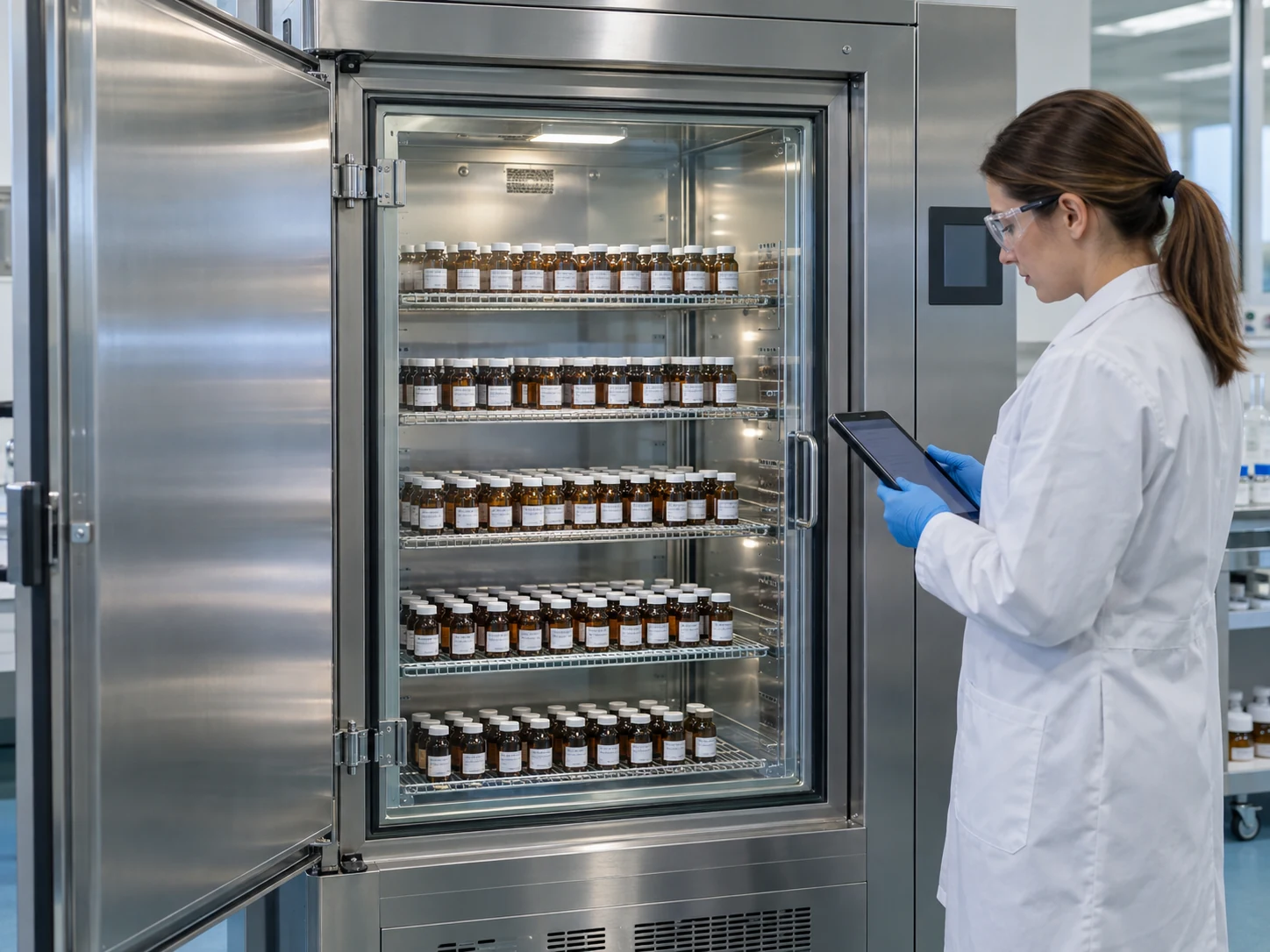
Stability chambers run for months at a defined temperature and humidity. A slow drift that no one is watching does not spoil one sample — it puts the entire time-point in question, and the study cannot be repeated on the original timeline.
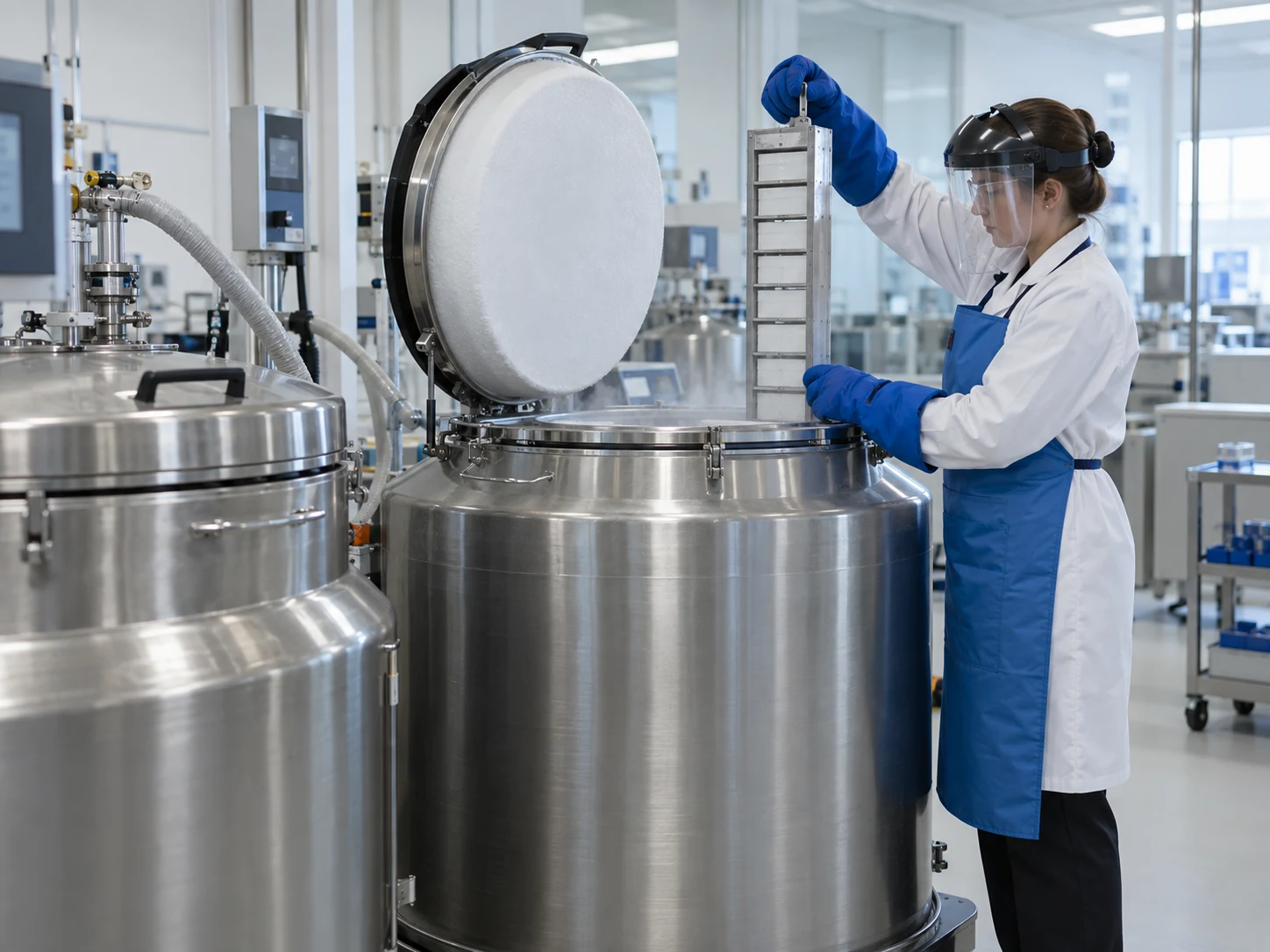
Liquid nitrogen consumption changes with lid cycling, ambient load, and tank age, so a fixed fill schedule is an assumption rather than a control. The same event that puts cell banks at risk displaces oxygen in the room, which makes it a staff safety matter as well as a product one.
For each of these, how long would it take to establish exactly when the interval began, and who was told?
Each failure mode is met by a measurement, not by a procedure.
Monitoring only prevents loss where the parameter that actually fails is the parameter being recorded. Qualified Controls specified the sensing layer against the four failure modes above, not against the equipment list.
A procedure asks a person to notice. A measurement records whether they did, and both outcomes are defensible only if the record exists before the question is asked.
A network or power interruption does not silence the system: readings buffer on the sensor and reconcile on reconnection, while independent uplinks carry the alarm out of the building. Off-hours escalation routes to on-call staff by role, with acknowledgement captured under electronic signature.
A door open past its threshold escalates on its own path, separate from a temperature excursion, so a busy production window never reads the same as a failed seal. Escalation is shift-aware and reaches the person on the floor rather than a distribution list.
Both parameters are evaluated on the same record with tiered thresholds, so a slow drift raises a tiered alarm and writes a timestamped interval to the audit trail long before a time-point is compromised.
Fill scheduling moves from a calendar assumption to an observed consumption rate, and the oxygen reading in the same repository gives facilities and safety one shared source. One record answers the product question and the personnel question at once.
One sensing layer, one record, every equipment class.
Qualified Controls walked every zone across the network, mapped each critical parameter to its governing specification, and designed a single Nano SPY sensing layer reporting into one validated MySirius account. Wireless range removed the need for new cabling in occupied production and laboratory space, and the legacy recorders were decommissioned only after the parallel run closed.
Every monitored unit records on a 15-minute interval with 5-minute alarm evaluation; humidity at 30 minutes, the most critical assets at one.
Redundant gateway coverage in every monitored zone with independent uplinks; on-sensor buffering holds data through network or power interruption.
Role-based routing with duration thresholds and shift-aware on-call chains, replacing per-device audible alarms across every equipment class.
ALCOA+ aligned audit trail with electronic signatures on every acknowledgement and corrective action.
Qualified on paper before it was trusted in practice.
Qualified Controls authored and executed the full validation package. Every sensor was calibrated against NIST-traceable standards, mapped to its asset, and signed off before the legacy loggers were removed.
Units taken out of service remain in documented maintenance mode. Every change of state is captured in the audit trail with an attributed electronic signature.
“We no longer assemble evidence when an inspector asks. The evidence already exists, it is signed, and it covers every minute since go-live.”
What is in service across the network.
Single-channel temperature recorder. Deployed across freezers, refrigerators, walk-ins, and cold rooms network-wide.
Combined temperature and humidity recorder. Covers ambient rooms, incubators, and fume hoods where humidity is a controlled parameter.
External-probe recorder for 4–20 mA, 0–1 V, and dry-contact inputs — LN2 level, O₂ monitors, CO₂, and door opening.
Digital recorder paired with Evolution low-temperature probes — every ultra-low freezer and LN2 tank in the estate.
Are all of your critical parameters being captured continuously?
The REM Risk Assessment documents every gap between what your specifications require and what your current system records. It takes one site visit.