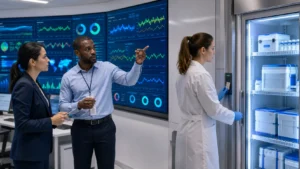
Real-Time Visibility That Protects Patients and Products
Real-time temperature monitoring in a hospital is not just a technical project; it is direct protection for patients and products. One missed excursion in a medication fridge, blood bank, or vaccine freezer can force hard questions. Is the product still safe? Do we delay treatment? Do we throw it away and start over?
As specialty drugs, biologics, and tissue products grow more common, the margin for error shrinks. Manual checks and paper logs cannot keep up with how often temperatures can drift. Doors get left open, compressors struggle, and power blinks during storms or summer heat.
That is why we believe real-time temperature monitoring, with clear governance, defined roles, and structured escalation workflows, is now a clinical, regulatory, and operational necessity. Sensors alone are not enough. Hospitals need a shared playbook that says who owns what, who responds first, and what happens next when an alert hits.
Why Real-Time Monitoring Is Now a Clinical Imperative
Many hospitals still rely on once-daily checks or clipboards taped to the side of a refrigerator. A staff member reads a dial and writes down a single number. The problem is that temperature drifts at any hour, not just when someone walks by with a pen.
Real-time temperature monitoring replaces guesswork with constant oversight. Wireless sensors and cloud software can watch pharmacy fridges, lab incubators, OR warmers, and storage rooms around the clock. When something starts to slip, the right team can know within minutes, not the next morning.
Key drivers for real-time monitoring include:
- Expectations from regulators and accreditors for cold chain integrity
- The need for traceable temperature records for every monitored asset
- Pressure to respond quickly to excursions and document every step
Bodies like The Joint Commission, CMS, and state boards of pharmacy expect hospitals to show that medication storage is controlled and documented. That means more than a stack of paper logs. It means audit-ready data and clear proof that the hospital responds when products are at risk.
Summer adds another layer. From June through September, heat waves strain chillers, HVAC, and backup systems. Power flickers can cause brief outages. In many regions, humidity climbs and mechanical rooms run hot. Real-time monitoring gives teams a chance to catch drift early, before a temporary stress becomes a full product loss.
Defining Ownership Across Biomed, Pharmacy, and Facilities
Even the best monitoring system fails if no one is sure who owns the alarms. Temperature touches many departments, and without clarity, alerts can get bounced from one group to another while products sit in the danger zone.
A simple starting point is to map ownership:
- Biomed or clinical engineering: warmers, incubators, clinical devices
- Pharmacy: medication fridges, freezers, vault storage, clean rooms
- Facilities: HVAC systems, central plant, walk-in rooms, building controls
From there, we suggest a cross-functional temperature governance committee. This group can include biomed, pharmacy, facilities, nursing leadership, quality, and IT. Its role is to set system-wide standards, approve corrective action templates, and decide how to prioritize remediation when resources are tight.
Clear, role-based accountability helps reduce overlap and finger-pointing. For example:
- Pharmacy managers own setpoints, product checks, and disposition decisions for drug storage
- Clinical engineers own calibration schedules and device performance
- Facilities supervisors own room temperature ranges and upstream HVAC issues
Each role should know: which assets they own, what alerts they receive, what actions they are expected to take, and how to document those actions. When that is written down, it becomes much easier to train new staff and keep everyone aligned.
Designing Escalation Workflows That Actually Work
Real-time alerts are only helpful if they lead to timely, repeatable action. That is where escalation workflows come in. Hospitals benefit from tiered response levels with clear time windows.
One simple model looks like this:
- Level 1: Frontline staff respond within a few minutes to check the unit, close doors, and confirm temperature
- Level 2: A supervisor or charge nurse weighs in within about 15 minutes if the alert does not clear
- Level 3: On-call pharmacist, biomed tech, or facilities lead gets involved if risk grows or equipment appears to be failing
Different risk thresholds can trigger different paths. A brief door-open event might stay at Level 1. A freezer slowly warming may jump quickly to Level 3 because product loss can happen fast.
Hospitals also need to think about channels and shift coverage. Alerts should not only go to email that no one checks at night. Strong programs use combinations of SMS, phone calls, and app notifications tied to on-call rotations. Nights, weekends, and holidays should all have at least one responsible owner for each asset type.
Runbooks and standard work turn those alerts into predictable action. For common alarms, such as:
- Refrigerator door left open
- Compressor failure
- Room temperature rising due to HVAC issues
- Power outage affecting multiple devices
There should be simple steps: immediate checks, product movement or quarantine if needed, who to call next, when to escalate to incident command, and what to document. When this is written and rehearsed, staff are calmer and faster in real events.
Leveraging Automated Systems for Compliance and Efficiency
A modern real-time monitoring platform ties everything together so teams can see the whole picture. Instead of scattered sensors and spreadsheets, a centralized dashboard shows pharmacy, lab, OR, and storage areas in one view.
Helpful features include:
- Wireless sensors linked to each asset, room, or zone
- Location tags that connect every sensor to a department and owner
- Predefined escalation paths tied to each monitored point
This kind of setup makes compliance far easier. Automated logging, exception reports, and validation records support audits and inspections without digging through paper. When surveyors ask who responded to a specific excursion, the record is already there, time-stamped and complete.
Another key piece is reducing alarm fatigue. If teams are flooded with alerts for normal events, such as brief door openings, they start to tune things out. Smarter rules and validated thresholds can filter out noise and focus attention on clinically meaningful changes. That keeps staff engaged and helps protect both patients and inventory.
Building a Hospital-Wide Playbook Before the Next Heat Wave
The best time to build or refine a real-time temperature monitoring strategy is before the next heat wave hits. Late spring is a good season to run a hospital-wide stress test.
A simple checklist might include:
- Verifying sensor coverage in high-risk areas
- Reviewing on-call lists and contact trees for nights and weekends
- Checking backup power plans for critical storage
- Testing sample alerts and walking through the response
To make this stick, hospitals can follow a clear sequence. Form a cross-functional governance group. Map monitored assets to clear owners. Define role-based workflows for common alarms. Configure alerts and escalation rules in the monitoring platform. Then run live simulations and refine the playbook together.
At Qualified Controls, we focus on automated, compliant real-time environmental monitoring and escalation workflows for regulated facilities that need 24/7 visibility and alerts. By combining wireless sensors, cloud software, and clear governance, hospitals can protect patients and products, support regulatory expectations, and run more resilient operations even when summer heat and aging infrastructure put systems under strain.
Protect Every Critical Asset With Continuous Temperature Insight
Our team at Qualified Controls is ready to help you safeguard products, equipment, and compliance with scalable, sensor-driven monitoring across all your locations. If you are looking for a reliable solution, explore how our real-time temperature monitoring platform can provide instant visibility and automated alerts. We will work with you to tailor a system that fits your facilities, integrates with your workflows, and grows as your operation expands.